
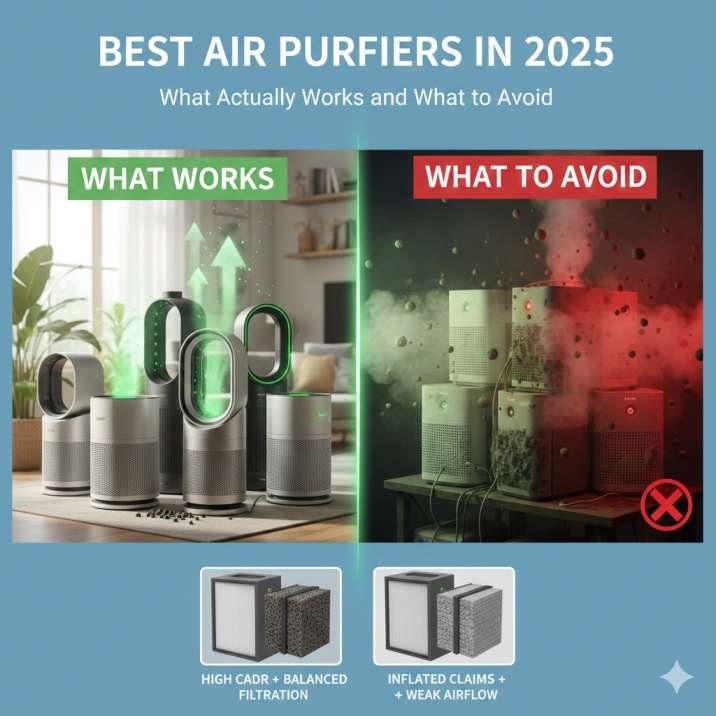

The best air purifiers are those that deliver strong airflow, reliable filtration, and quiet operation while remaining cost-effective to run. Choosing a properly sized purifier with proven performance helps improve indoor air quality and ensures consistent, noticeable results.
The best air purifiers combine powerful airflow, effective filtration, and quiet everyday performance to improve indoor air quality. While many models promise impressive results, real effectiveness depends on measurable performance rather than marketing claims. This guide explains what actually works, what to avoid, and how to choose an air purifier that delivers cleaner, healthier air for your home.
Brands Referenced in This Guide
This article focuses on how the best air purifiers work rather than promoting specific products. However, real-world examples help explain why certain designs consistently perform better.
Levoit models are commonly viewed as dependable baseline options for everyday use, while Coway units demonstrate why high clean air delivery is critical in large or open-plan spaces.Compact designs from Xiaomi — along with models like the freshia air purifier — show that smaller purifiers can still be effective when engineered properly.
Winix products highlight the value of optional features such as ionisers that users can control. Airflow-focused designs from AirFanta and CleanAirKits illustrate how performance-driven construction can sometimes outperform more expensive retail models.
Heavy carbon filtration, often associated with brands like Austin Air and Alen, reinforces an important lesson: serious odour and chemical removal requires far more activated carbon than most standard units provide. Meanwhile, commercial-focused companies such as Smart Air emphasize durability and airflow over automation.
DIY solutions like the Corsi–Rosenthal Box help demonstrate the core principles of air cleaning, though they are typically better suited to temporary situations than permanent home use.
Choosing the Best Air Purifiers for Your Space
The best air purifiers are those that match your room size and deliver enough airflow to clean the air consistently. For most homes, mid-sized units offer the strongest balance of performance, quiet operation, and energy efficiency, making them ideal for everyday use.
Compact purifiers can work well in smaller rooms such as bedrooms or home offices, but only when their airflow is appropriate for the space. Larger and open-plan areas demand high-CADR models, as standard units often struggle to maintain healthy air quality in bigger environments.
Quiet operation should also be a priority. Larger purifiers running at lower fan speeds typically clean more effectively while producing less noise than smaller devices operating at full power.
Special Situations That Require More Powerful Filtration
Some air quality concerns demand stronger filtration. If smoke, chemicals, or persistent odours are present, choosing a purifier with substantial activated carbon is essential. Thin carbon filters tend to lose effectiveness quickly and rarely provide lasting improvement.
Portable and DIY air cleaners can help in temporary situations, but they usually cannot match the performance, safety, or long-term reliability of a properly sized home air purifier. Investing in the right model from the start is far more effective than relying on short-term solutions.
What to Avoid When Buying an Best Air Purifier
Several warning signs can indicate that a purifier may underperform. Inflated room-size claims are among the most common issues and are often based on unrealistically low air circulation levels. Excessive noise at effective speeds is another concern, as a purifier that is too loud is less likely to be used consistently.
Non-disableable ionisers may deter some buyers, while high prices unsupported by airflow or filtration quality should always prompt closer scrutiny. Avoiding these pitfalls makes it much easier to choose one of the best air purifiers while preventing unnecessary expense and frustration.
Why Bigger Often Means Quieter
Smaller air purifiers must spin their fans faster to move sufficient air, which usually increases noise. Larger units can circulate the same volume more slowly, resulting in quieter and often more efficient operation.
Choosing a slightly larger purifier than you initially planned can improve both comfort and cleaning effectiveness, especially in spaces where continuous operation is important.
Long-Term Costs Matter More Than Purchase Price
Running an air purifier continuously is one of the most effective ways to maintain healthy indoor air. Many well-designed models are energy efficient, but operating costs still vary.
Filter lifespan and replacement pricing should always be considered before buying, as they significantly influence long-term affordability. A purifier that is inexpensive to operate is far more likely to remain in constant use — and consistency is what delivers measurable air quality improvements.
Smart Features: Helpful but Secondary
Modern air purifiers often include apps, sensors, and automated modes. While these features can enhance convenience, they should never replace core performance. A basic purifier that moves enough clean air will almost always outperform a feature-heavy model with weak airflow.
Prioritizing performance first and technology second is typically the smarter approach.
Why So Many Air Purifiers Underperform
One of the main reasons air purifiers fail to meet expectations is how their performance is presented. Some manufacturers calculate room size using only one air change per hour, which is rarely enough to noticeably reduce allergens, smoke, or fine particles. Most spaces require roughly four to five air changes per hour for meaningful improvement.
Filtration claims can also create confusion. Terms such as “HEPA-style” or “medical grade” are sometimes used without clear certification, and carbon filters are often too thin to manage odours for extended periods. As a result, many popular models appear capable but struggle to deliver consistent real-world results.
What Makes the Best Air Purifiers Effective
An air purifier’s effectiveness depends largely on how much clean air it can circulate through a room. Clean Air Delivery Rate is one of the most useful metrics because it indicates how quickly a unit removes airborne particles.
Filtration quality is equally important. True HEPA filters are engineered to capture extremely small pollutants such as dust, pollen, and fine particulate matter, though not every product labeled “HEPA” meets the same standard.
Some alternative technologies treat air and surfaces rather than filtering mechanically, but these systems are typically designed for commercial or high-traffic environments rather than typical homes.
Practical considerations — including noise levels and running costs — ultimately determine whether a purifier is used consistently. The best air purifiers are those that clean effectively while remaining quiet and affordable enough to operate every day.
Conclusion
The best air purifiers in 2026 are defined by measurable airflow, dependable filtration, realistic noise levels, and long-term usability rather than brand recognition alone. When you focus on these fundamentals, selecting the right purifier becomes far more straightforward.
Choosing wisely is not just about comparing specifications — it is an investment in cleaner air, greater comfort, and a healthier indoor environment.
Frequently Asked Questions
What is the best air purifier in 2026?
The best air purifier is one that matches your room size, delivers strong clean air output, uses reliable filtration, and operates quietly enough for continuous use.
Do air purifiers really work?
Yes. When properly sized and used consistently, air purifiers can significantly reduce airborne dust, pollen, smoke, and fine particles, a benefit widely supported by the Asthma and Allergy Foundation of America.
What size air purifier do I need?
Select a purifier based on Clean Air Delivery Rate rather than advertised room size. Ideally, the unit should clean the air several times per hour.
Are HEPA air purifiers worth buying?
True HEPA purifiers are a strong choice for capturing very small airborne particles — especially when choosing a hepa air purifier uk designed for consistent filtration
Can air purifiers remove odours?
They can reduce smoke particles, but effective odour removal typically requires substantial activated carbon.
Should I run my air purifier all the time?
Continuous operation is usually the most effective strategy for maintaining stable indoor air quality.
How often should filters be replaced?
Filter lifespan varies by model and usage. Some require replacement every six months, while others can last a year or longer. Checking availability and cost beforehand helps prevent unexpected expenses.