
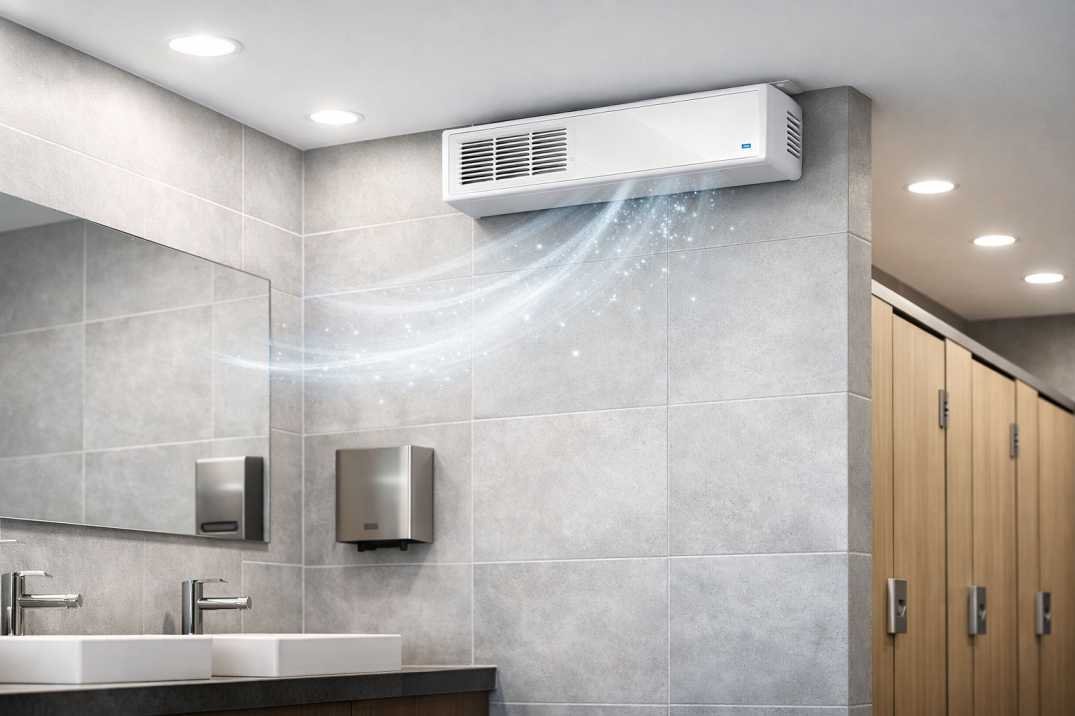

The BioZone air purifier is a commercial hygiene system that improves air and surface cleanliness by actively removing odours, bacteria and airborne contaminants instead of just filtering the air. It uses UV-based technologies like Photoplasma™ and UVGI to treat the whole environment, which makes it ideal for washrooms, hospitality areas and other high-traffic commercial spaces.
Indoor air quality is now a major concern in commercial and public spaces because hygiene, odour control and cleanliness directly affect customer experience and business reputation. Washrooms, kitchens, hotels and shared indoor spaces constantly battle odours, airborne bacteria, surface contamination and chemical fumes from cleaning products. Traditional air purifiers and fragrance systems often fail because they only filter air or mask smells instead of removing the real source of odours and contamination. The BioZone air purifier takes a different approach. Instead of filtering air or covering smells, BioZone systems actively treat both air and surfaces to remove contaminants across the whole space. Designed primarily for professional environments, BioZone focuses on continuous hygiene, odour destruction and environmental control. This article explains how BioZone air purifiers work, the technologies behind them, where they perform best and who they are designed for.
What Is a BioZone Air Purifier?
A BioZone air purifier is a commercial-grade environmental hygiene system designed to improve indoor air and surface conditions by neutralising contaminants at a molecular level across an entire space. Unlike household air purifiers that rely on filters, BioZone systems release controlled active agents into the space to treat the environment directly. These agents actively interact with odour-causing bacteria, microorganisms and gaseous pollutants wherever they form within the environment.
The technology is developed by BioZone, a brand focused on professional air hygiene rather than consumer household appliances. As a result, BioZone systems are most commonly installed in washrooms, commercial kitchens, hospitality venues, offices, gyms, healthcare facilities and retail environments where odours and microbial contamination are persistent and difficult to control.
BioZone air purifiers are designed to run continuously, helping maintain a steady and reliable level of hygiene all day.
How BioZone Air Purifiers Work
BioZone air purifiers function through active air and surface treatment, not passive filtration. Inside the unit, ultraviolet energy interacts with air molecules, triggering reactions that generate highly reactive compounds. These compounds disperse naturally throughout the space instead of remaining confined to the unit itself.
When these active agents come into contact with bacteria, viruses, mould, odours or chemical gases, they break them down and make them harmless. This renders contaminants inactive rather than simply trapping or covering them. Because it treats the entire environment, the system reaches places traditional air purifiers cannot, such as surfaces, furniture, corners and still air areas.ir zones.
This approach allows BioZone systems to address the root causes of odours and hygiene issues, rather than dealing only with particles passing through a filter.
Photoplasma™ Technology Explained
Photoplasma™ is BioZone’s main technology that treats air and surfaces to control odours and germs in commercial spaces where people are present. It produces a controlled mix of reactive oxygen species, including ions and hydroxyl radicals, which actively seek out contaminants in both air and on exposed surfaces.
Unlike filtration-based systems, Photoplasma™ does not rely on airflow passing through a device. Instead, it creates an environment-wide treatment effect that extends across the entire room. This creates a 360-degree clean-air effect, treating contaminants wherever they appear in the room.
Photoplasma™ works continuously in occupied spaces and is particularly effective at neutralising odours because it targets the bacteria responsible for producing them. This makes it well suited to washrooms, kitchens and hospitality environments where odours originate from multiple sources and persist despite regular cleaning.
UVGI: Germicidal Control in Targeted Areas
UVGI, or Ultraviolet Germicidal Irradiation, is another core technology used in BioZone systems. It employs short-wave UV-C light to disrupt the DNA of microorganisms, preventing them from growing or reproducing.
UVGI has long been used in healthcare and HVAC systems because it operates without chemical residues and is highly effective in controlled airflow environments. Within BioZone products, UVGI is often applied where air is channelled through ducts, coils or enclosed systems, allowing targeted disinfection of air streams and internal components.
In these settings, UVGI supports overall hygiene by limiting microbial build-up inside ventilation systems, which can otherwise become hidden sources of contamination.
How BioZone Technologies Work Together
Many BioZone systems combine Photoplasma™ and UVGI to create a multi-layered approach to air and surface hygiene. Instead of using one method for all spaces, BioZone adjusts its technology based on the environment.
In open spaces such as washrooms or hospitality areas, Photoplasma™ treats the room as a whole, neutralising contaminants wherever they appear. In HVAC systems or air handling units, high-output UVGI focuses on disinfecting airflow and internal components. This flexibility allows BioZone systems to deliver the right level of treatment without over-application or unnecessary complexity.
BioZone AC®: A Dedicated Washroom Solution
BioZone AC® is a system specifically designed for commercial washrooms and sanitary facilities, where odour control, surface hygiene and air quality challenges differ significantly from other indoor environments. Washrooms have moisture, strong odours, frequent use and cleaning chemicals, which makes them hard to manage with traditional air fresheners or filters.
BioZone AC® treats both air and surfaces simultaneously, helping to reduce odours, bacteria and mould between cleaning cycles. Instead of masking smells with fragrance, it eliminates odours by targeting the bacteria that cause them. This results in a cleaner-smelling space without introducing artificial scents that some users find unpleasant.
The system is engineered to perform reliably even in high-traffic washrooms, such as those found in shopping centres, airports, workplaces and hospitality venues.
Continuous Operation in Short-Exposure Spaces
BioZone systems work well in washrooms because people usually spend only a short time in these spaces. People typically spend limited time in these spaces, which allows the system to operate continuously throughout the day without disrupting occupants.
Continuous operation helps maintain consistent hygiene, reduces odour build-up and supports cleanliness between scheduled cleaning routines. Importantly, BioZone systems are designed to support, not replace, regular manual cleaning. Their role is to help maintain environmental hygiene during periods when cleaning is not actively taking place.
Energy Efficiency and Sustainability
Despite operating continuously, BioZone air purifiers are designed for low energy consumption. Many BioZone models consume energy comparable to a low-energy light bulb, making them suitable for continuous operation without increasing operational costs, making them suitable for long-term use without significant operating costs.
Because BioZone systems do not use filters, fragrances or chemical refills, they reduce waste and ongoing supply needs. This makes them appealing to organisations pursuing sustainability goals or seeking alternatives to chemical-heavy hygiene solutions.
Practical Design and Facility Management Features
BioZone air purifiers are designed with professional environments in mind. Units are compact, discreet and suitable for wall or ceiling installation, allowing them to blend into public spaces without drawing attention.
Many models include integrated monitoring and control features that support maintenance planning and operational oversight. These features help facility managers track runtime, monitor system status and schedule servicing without complex external equipment.
Room Size Options and Scalability
BioZone washroom systems are available in multiple size configurations, allowing treatment to be matched precisely to the room rather than applying a one-size-fits-all solution. Common coverage options include:
- 10 square metre rooms
- 20 square metre rooms
- 30 square metre rooms
This scalability ensures effective hygiene without over-treating small spaces or under-treating larger ones.
BioZone vs Traditional HEPA Air Purifiers
Traditional HEPA air purifiers are widely used in residential settings, particularly across the UK, where households aim to reduce dust, pollen and airborne allergens in enclosed living spaces. These systems work by physically trapping particles as air passes through dense filters, making them well suited to bedrooms, living rooms and homes where people spend long periods indoors. If you’re looking for a deeper understanding of how these systems work and what to consider when choosing one, this guide on HEPA air purifier UK explains the differences in detail.
By comparison, BioZone air purifiers are engineered specifically for commercial environments, where odour management and hygiene consistency matter more than particle filtration alone. Instead of focusing on particle filtration, they treat air and surfaces throughout a space to manage odours and environmental hygiene in shared, high-traffic areas such as washrooms, hospitality venues and public buildings. The two technologies serve different purposes, and choosing between them depends on whether the priority is residential air filtration or commercial hygiene control.
Technical Specifications (Where Bullets Add Clarity)
For facilities planning and installation, key technical specifications typically include:
- Input voltage: 240 VAC
- Frequency: 50 Hz
- Power consumption: approximately 24 W
- Wall or ceiling mountable design
- Compact, space-saving form factor
These details are particularly useful for installers and facilities teams working within defined electrical and spatial constraints.
BioZone vs Traditional HEPA Air Purifiers
BioZone air purifiers and HEPA air purifiers are often compared, but they serve fundamentally different purposes. HEPA systems are designed to physically capture particles such as dust and pollen by forcing air through dense filters. This makes them ideal for homes and allergy-sensitive environments.
BioZone systems, on the other hand, focus on environmental hygiene. They treat air and surfaces directly, targeting odours, bacteria and gaseous pollutants rather than particulate matter. In many commercial settings, these technologies are complementary, with HEPA filtration used in certain zones and BioZone systems supporting hygiene across shared spaces.
Who BioZone Air Purifiers Are Best For
BioZone air purifiers are best suited to environments where odour control and hygiene consistency are ongoing challenges. These include washrooms, commercial kitchens, hospitality venues, gyms, offices and public buildings.
They are not typically intended for private residential spaces such as bedrooms or nurseries, where people spend extended periods of time and where HEPA filtration is usually more appropriate.
Safety and Responsible Use
BioZone systems are engineered to operate within recognised indoor safety limits when installed and calibrated correctly. Because they are designed for professional environments, installation is typically carried out by trained technicians who ensure appropriate placement and operation.
As with any professional air treatment system, suitability depends on correct installation, space size and intended use rather than individual household needs. BioZone systems are designed for professional hygiene use, not for personal or home wellness purposes.
Conclusion
The BioZone air purifier is a specialised solution for managing air and surface hygiene in commercial and public environments. By combining technologies such as Photoplasma™ and UVGI, BioZone systems treat the environment itself, neutralising odours and reducing microbial presence throughout a space. They do not replace HEPA air purifiers or regular cleaning, but they help maintain consistent hygiene in busy shared spaces. When installed in the right commercial settings—particularly washrooms, hospitality venues and shared indoor environments—BioZone air purifiers provide a low-maintenance, energy-efficient solution for maintaining consistent hygiene and long-lasting freshness.
Frequently Asked Questions (FAQs)
What is a BioZone air purifier used for in commercial spaces?
A BioZone air purifier is used in commercial and public environments to help manage odours, airborne contaminants and surface hygiene. It is commonly installed in washrooms, commercial kitchens, hospitality venues, offices and gyms where traditional air filtration or fragrance systems are not effective.
How does a BioZone air purifier work?
BioZone air purifiers work by treating the air and surrounding surfaces rather than filtering air through a physical filter. Using UV-based technologies, the system generates reactive agents that disperse throughout the space and interact with odours, bacteria and gaseous pollutants, helping to neutralise them at their source.
Is a BioZone air purifier safe to use?
When installed and calibrated correctly in professional environments, BioZone air purifiers are designed to operate within recognised indoor safety limits. They are intended for commercial use rather than personal living spaces, and are most suitable for areas where people are present for short periods, such as washrooms and shared facilities.
Can a BioZone air purifier be used in homes?
BioZone air purifiers are primarily designed for commercial and public spaces. For residential settings such as bedrooms or living rooms, HEPA-based air purifiers are generally more appropriate, especially for people with allergies or respiratory sensitivities.
Does a BioZone air purifier remove odours or just mask them?
A BioZone air purifier removes odours by targeting the bacteria and organic compounds that cause them, rather than masking smells with fragrance. This makes it particularly effective in environments where odours return quickly after cleaning or where fragrance dispensers are unsuitable.
Does BioZone replace regular cleaning?
No. BioZone systems are designed to support hygiene standards, not replace manual cleaning. They help maintain cleanliness and reduce odours between cleaning cycles, especially in high-traffic areas, but routine cleaning remains essential.
What is the difference between a BioZone air purifier and a HEPA air purifier?
HEPA air purifiers remove particles such as dust and pollen by forcing air through dense filters. BioZone air purifiers treat the environment itself, focusing on odours, bacteria and gaseous pollutants. The two systems serve different purposes and may be used together in some commercial settings.
Is a BioZone air purifier suitable for washrooms?
Yes. BioZone systems are particularly well suited to washrooms because they address odours, bacteria, mould and chemical fumes in high-humidity, high-traffic environments. They are designed to operate continuously and discreetly throughout the day.
How much maintenance does a BioZone air purifier require?
BioZone air purifiers require minimal maintenance compared to filter-based systems. There are no fragrance cartridges or filters to replace, and most models only require periodic inspection and scheduled component servicing.
Does a BioZone air purifier consume a lot of electricity?
No. BioZone systems are designed for low energy consumption and typically use power comparable to a low-energy light bulb, making them suitable for continuous operation without significant running costs.
Who should consider installing a BioZone air purifier?
BioZone air purifiers are best suited for facility managers, business owners and organisations responsible for maintaining hygiene and odour control in shared indoor environments such as washrooms, hospitality venues, offices, gyms and public buildings.