
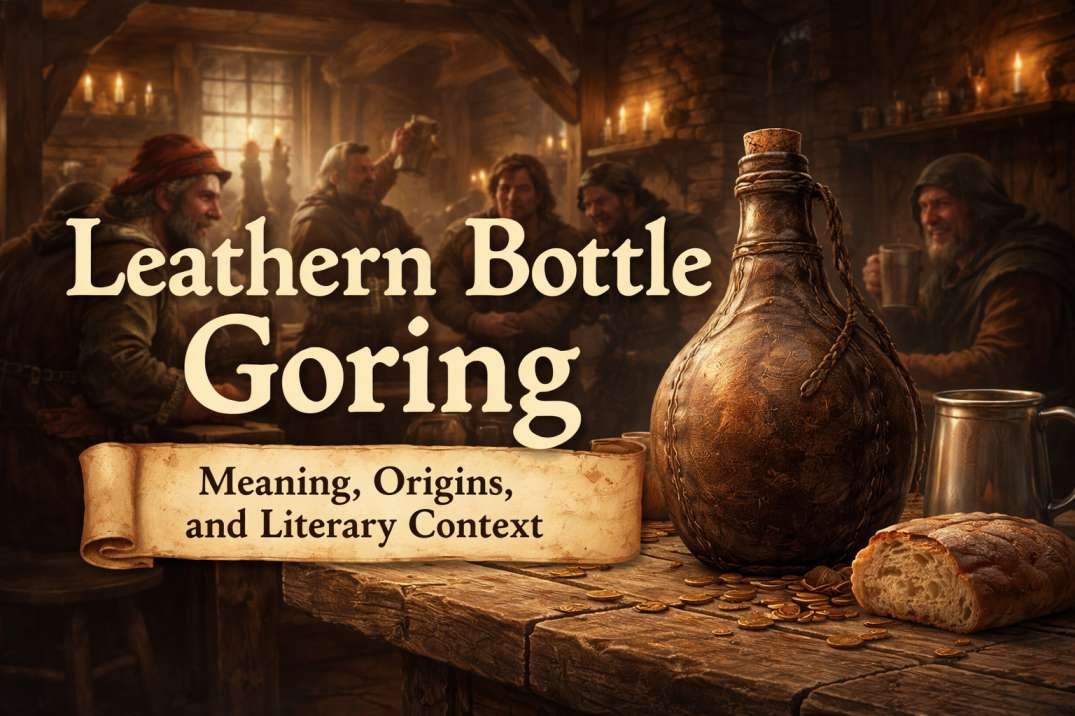

Leathern bottle goring is an archaic English phrase from medieval and early modern England, used to create vivid imagery of chaos, excess, or reckless behaviour, where language relied heavily on physical imagery drawn from everyday experience. By combining a familiar object with violent action, the phrase reflects a period when speech was expressive, exaggerated, and closely connected to material culture and social behaviour.
The English language contains many forgotten expressions that once felt natural to speakers but now appear dramatic, confusing, or even bizarre to modern readers. Leathern bottle goring is one such phrase. Rarely used in modern speech, it often appears in older texts, leaving readers unsure of its meaning or intent. Rather than being random, the phrase reflects a time when language drew heavily from familiar objects and lived experience. Understanding it requires stepping back into a time when speech and writing favoured vivid imagery, exaggeration, and symbolic action. Exploring this phrase helps illuminate how earlier English speakers used language to entertain, emphasise, and communicate social behaviour.
What Does “Leathern Bottle Goring” Mean?
At its most basic level, leathern bottle goring refers to the act of violently piercing or tearing a drinking bottle made from leather, an object once commonly used in everyday life. The phrase is built from two concrete elements: a leathern bottle, which was a common historical drinking vessel, and goring, a word associated with forceful stabbing or ripping. Together, they form a striking image of destruction applied to an ordinary object. In most contexts, the phrase is not meant to describe a literal action but instead functions as exaggerated imagery used to suggest chaos, excess, recklessness, or loss of control.
The Leathern Bottle in Everyday History
Before glass bottles became widely available, leathern bottles were a practical and widely used method of carrying liquids such as water, ale, or wine, particularly among travellers, soldiers, and labourers. Made from treated animal hide, they were flexible, portable, and widely used by travellers, soldiers, and labourers. Because these bottles were part of everyday life, they naturally appeared in speech and storytelling. Damaging such an object would have been seen as wasteful or foolish, making it a powerful symbol when paired with violent language.
The Meaning of “Goring” in Older English
The word goring has long carried strong associations with violence and force, as defined in historical dictionaries such as the Oxford English Dictionary.. Historically, the word was used to describe animals piercing with horns, weapons tearing into flesh, or sudden, forceful acts of destruction, all of which carried strong emotional and visual impact. Applying this word to an everyday object intensifies the image and adds drama. It turns a simple act into something excessive and unruly, which is why writers found it effective in expressive language.
Literal Meaning Versus Figurative Use
for example, a writer describing a rowdy tavern scene might use the phrase to imply behaviour so uncontrolled that even useful objects were being destroyed in the chaos.While the phrase can be understood literally, its impact lies mainly in figurative use. In a literal sense, it suggests a leather bottle being stabbed or ripped open. Figuratively, it represents reckless behaviour, exaggerated violence, or mock heroics, often used to ridicule excess rather than glorify real aggression. Writers often used such imagery to ridicule excess or emphasise disorder rather than to describe real harm.
Historical and Linguistic Origins
Leathern bottle goring fits comfortably within medieval and early modern English, a period known for bold, physical language. Writing from this era often blended humour, violence, and familiar objects to create memorable expressions. Ballads, poems, and popular verse relied on vivid imagery to capture attention, especially in oral storytelling. A phrase like this would have stood out clearly to listeners and readers alike.
Some historians link the popularity of leathern bottles to traditional English folk culture, where they frequently appeared in ballads and drinking songs such as “The Leathern Bottel,” a well-known seventeenth-century broadside. References like these suggest that the object was culturally recognisable, making it effective material for dramatic expression.
Use in Literature and Popular Writing
scenes of drinking, feasting, boasting, and fighting — social traditions that continue to influence how beverages are presented today, from taverns to branded containers like the Cobra Bottle. The leathern bottle, closely associated with alcohol and social life, became a useful symbol in such contexts. The phrase could suggest disorder at a tavern, foolish bravado, or comic exaggeration. Rather than glorifying violence, the phrase often highlighted how uncontrolled, foolish, or absurd a situation had become, especially in social or drinking-related settings.
Symbolic Interpretation
Symbolically, the phrase combines the idea of the bottle, representing sustenance, indulgence, or social ritual, with goring, representing destruction or loss of control. Together, these elements can symbolise excess, self-sabotage, or the breakdown of social order, reinforcing the moral or satirical tone common in early English writing. This symbolic depth helps explain why the phrase continues to attract interest among readers and language enthusiasts.
Why the Phrase Fell Out of Use
Several cultural and linguistic shifts contributed to the disappearance of leathern bottle goring from everyday language over time. As glass and later metal containers replaced leather vessels, the object at the centre of the phrase faded from common experience. When physical references disappear from daily life, the expressions built around them often vanish as wel, English has shifted toward simpler expression, and violent metaphors are now used differently. Studying expressions like leathern bottle goring reminds us that language evolves alongside culture, preserving traces of how earlier societies understood humour, behaviour, and everyday life.
Why People Still Search for the Phrase
Today, people usually encounter leathern bottle goring through historical reading, academic study, or curiosity about obscure expressions. Most searches are driven by a desire to understand meaning and context rather than to use the phrase in modern writing.
Common Misunderstandings
It is not modern slang
It does not usually describe real violence
It is not a fixed idiom but vivid descriptive imagery
Conclusion
Leathern bottle goring offers a clear example of how expressive and physical older English could be. Rooted in everyday medieval life, the phrase combines familiar objects with exaggerated violence to create imagery that is symbolic, memorable, and often humorous. Although it has disappeared from modern speech, understanding it helps preserve insight into historical language and storytelling traditions. Far from being meaningless or crude, the phrase reflects the rich, imaginative nature of earlier English, offering modern readers valuable insight into how language once captured everyday life, humour, and social behaviour.
Frequently Asked Questions (FAQs)
What does leathern bottle goring mean?
Leathern bottle goring means violently piercing or tearing a bottle made from leather. In most cases, it is used as exaggerated or symbolic imagery in older English writing rather than to describe a real action.
Is leathern bottle goring a real historical phrase?
Yes, it reflects genuine language patterns from medieval and early modern English. While rare, it is built from historically accurate objects and words that were commonly understood at the time.
What is a leathern bottle?
A leathern bottle was a drinking vessel made from treated animal hide, much like early versions of modern bottles such as Dragon Soop Bottle. It was widely used in England before glass bottles became common, especially by travellers, soldiers, and labourers.
Is leathern bottle goring used in modern English?
No, the phrase is considered obsolete. It mainly appears in historical texts, literary analysis, or academic discussion and is not used in everyday modern language.
Does leathern bottle goring describe real violence?
Usually no. While the words are violent, the phrase is often metaphorical or exaggerated, used for dramatic, satirical, or symbolic effect in older writing.
Where might I encounter this phrase today?
Most people encounter leathern bottle goring while reading older literature, studying historical English, or searching for explanations of obscure or archaic expressions.
Is leathern bottle goring an idiom?
Not in the modern sense. It functions more as vivid descriptive imagery rather than a fixed idiom with a standardised meaning.
Why do people still search for leathern bottle goring?
People usually search for it out of curiosity, academic study, or confusion after encountering it in an old text. Searches are typically informational, focused on meaning and context.