
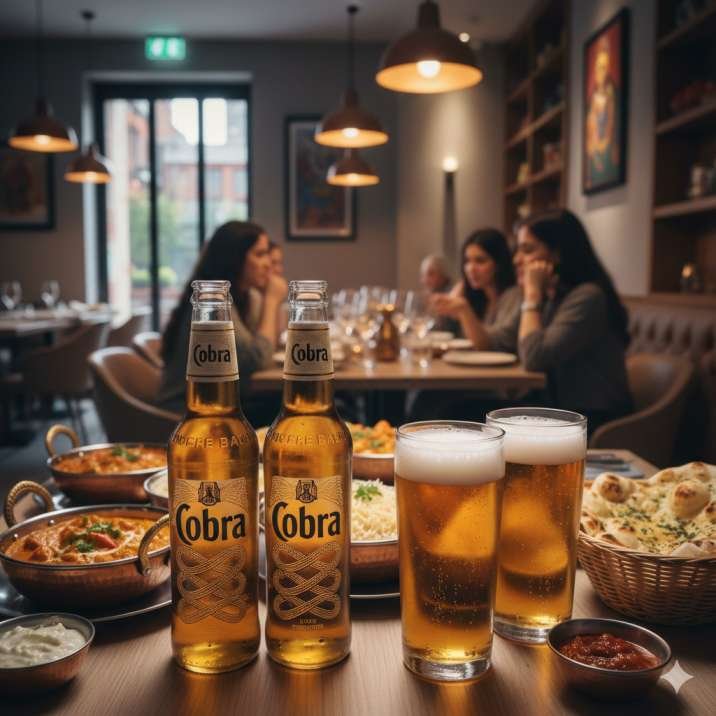

Cobra Beer is a premium lager brand recognised for its smooth mouthfeel, lower carbonation and distinctive embossed bottle design, created specifically to be enjoyed with food. Founded in 1989, it combines a unique grain blend with refined brewing to complement food, especially Indian cuisine. Its embossed bottle and global success set it apart.
The Cobra Beer bottle is a familiar sight on dining tables, especially alongside Indian cuisine, yet few people realise the level of design thinking, cultural influence and brewing philosophy behind it. The Cobra Beer bottle is more than just packaging; it represents the brand’s focus on smooth taste, balance, and premium quality. From its distinctive tall profile and embossed glass to the beer’s carefully balanced recipe and global production journey, Cobra Beer has carved out a unique position in the beer market. This article brings together the brand’s history, bottle design, ingredients, taste profile, business evolution and cultural impact to present a complete, trustworthy guide to Cobra Beer and its iconic bottle.
What Is Cobra Beer?
Cobra Beer is a premium lager brand brewed for the UK market, widely recognised for its smooth taste, lower carbonation and exceptional compatibility with food. It is commonly associated with Indian restaurants in the UK, where it has become a default beer choice for many diners. The brand’s primary product is Cobra Premium Beer, which currently has an alcohol strength of 4.5% ABV, reduced from its original 4.8%.
Cobra Beer was created to solve a common dining issue, as many lagers felt too fizzy with food, while traditional ales were often too bitter or heavy. Cobra was designed to sit comfortably between the two, offering refreshment without overwhelming either the palate or the meal.
Founding Story and Early Vision
Founded in 1989 by Karan Bilimoria alongside brewing partner Arjun Reddy, Cobra Beer was developed from the outset as a lager designed explicitly for dining rather than casual drinking. At the time, Bilimoria was just 27 years old and heavily in debt, but He noticed that there was no beer designed specifically to be smooth and easy to drink with food.. His idea was to create a lager with the drinkability of a light beer and the smoothness typically associated with ale.
Interestingly, the brand was not originally intended to be called Cobra. The initial name considered was “Panther”, but focus group testing revealed that “Cobra” was more appealing, memorable and culturally resonant. That decision would go on to define the brand’s identity.
The first shipment of Cobra Beer arrived in the UK in 1990, brewed at the Mysore Brewery in Bangalore. However, the early 1990s recession and rising import costs soon made overseas production unsustainable, leading to a strategic shift towards UK brewing.
Where Cobra Beer Is Brewed
Over time, Cobra Beer evolved into an internationally produced brand, with brewing locations chosen to balance scale, consistency and quality control. As of the mid-2010s, production has taken place in multiple locations, including:
- Burton upon Trent, England
- Rodenbach, Belgium
- Patna, Bihar, India
Brewing in multiple locations helps Cobra Beer grow worldwide while keeping the taste and quality consistent. Earlier in its journey, from 1996 onward, Cobra was brewed under contract by Charles Wells Ltd, a period that coincided with steady growth.
Ownership, Financial Challenges and Recovery
Despite growing brand recognition and strong on-trade presence, Cobra Beer faced significant financial challenges in the mid-2000s. By 2007, the company was reporting losses of £13.6 million, placing increasing strain on its operating model despite strong brand recognition and By 2008, the company had debts of around £26 million, much of it from high-interest loans.
In May 2009, Cobra Beer entered administration, owing an estimated £75 million to suppliers. On the same day, the brand was saved through a partnership with Molson Coors., which provided financial stability and long-term scale. a joint venture between Karan Bilimoria and Molson Coors, with Molson Coors taking a controlling stake.
By 2011, Molson Coors had also acquired a majority share in Cobra’s Indian operations. Since then, the business has stabilised and returned to profitability, with steady year-on-year growth and strong performance in the UK hospitality sector.
Ingredients and Brewing Approach
One of the key features of Cobra Beer is its carefully chosen grain blend, created to be smooth, balanced, and easy to drink with food, which sets it apart from many standard mass-market lagers. Cobra Beer is brewed using:
- Water
- Malted barley
- Yeast
- Rice
- Maize
- Wheat
- Three varieties of hops
The inclusion of rice and maize plays a key role in achieving Cobra’s smooth mouthfeel and reduced gassiness. In the UK bottled version, sugar is also listed as an ingredient, contributing to fermentation and balance.
This carefully chosen grain mix helps produce a beer that is lighter on the stomach while retaining enough body to stand up to richly spiced food.
The Cobra Beer Bottle Design
The Cobra Beer bottle plays a central role in the brand’s identity, acting as a visual and tactile expression of its premium, food-focused philosophy. Its design communicates premium quality without relying on flashy graphics.
Shape and Profile
The Cobra Beer bottle features a tall, slim profile that gives it an elegant, premium presence on restaurant tables. This height differentiates it from shorter, bulkier lager bottles and reinforces the brand’s refined positioning.
Embossed Glass Texture
One of the most unique features of the Cobra Beer bottle is its embossed glass. Rather than being completely smooth, the bottle features raised designs that you can physically feel when holding it. The embossed glass features traditional and symbolic motifs — including snakes, elephants, palm trees and boats — creating a tactile surface that reinforces the brand’s cultural roots and premium positioning. Textured beer bottles are uncommon, and Cobra’s embossed glass makes the bottle feel more premium and memorable.
Labels and Branding
Cobra uses a large neck label and a narrow wrap-around label on the body. Most key information — including alcohol content, smoothness claims and brand messaging — is placed on the neck, allowing the bottle itself to remain visually clean.
Bottle Cap and Small Branding Details
Attention to detail extends even to the bottle cap. Cobra Beer bottles often feature:
- Extensive printed text on the top of the cap
- Awards or branding printed inside the cap, something rarely seen in beer packaging
Some caps reference CoolBrands awards, highlighting innovation, style and desirability. These small touches reinforce the sense that Cobra is carefully designed rather than mass-produced.
Alcohol Strength and Variations
Cobra Premium Beer currently sits at 4.5% ABV, with draught versions slightly lower. The brand also offers:
- Cobra Zero (0.0%), a non-alcoholic option
- King Cobra (5.2%), a premium pilsner-style lager
King Cobra is particularly notable for being bottle-fermented, a process more commonly associated with champagne and some ales, adding depth and refinement.
Pour, Appearance and Carbonation
When poured, Cobra Beer produces a lively head that quickly settles, leaving a clean surface with gentle carbonation. The beer itself has a golden amber hue, lighter than many ales but richer than very pale lagers.
One of Cobra’s defining characteristics is that it is less gassy than typical lagers. This is not just a marketing claim, as the carbonation is noticeably softer and gentler, making it easier to drink over a meal.
Aroma and Taste Profile
On the nose, Cobra Beer smells familiar yet slightly different from standard lagers. Malted barley, yeast and hops are present, but there is an added softness that likely comes from the rice and maize.
The taste profile is where Cobra Beer truly distinguishes itself from standard lagers. No single flavour stands out too strongly; instead, the beer is smooth and well balanced. Instead, the beer delivers:
- Mild bitterness that does not linger
- Subtle grain notes
- A rounded, smooth mouthfeel
- Enough body to feel satisfying, without heaviness
Because the flavours are balanced rather than bold, Cobra Beer rarely overwhelms food, making it particularly suitable for spicy dishes.
Why Cobra Beer Works So Well With Food
Cobra Beer has become closely associated with curry and Indian cuisine because it was explicitly designed to complement complex, spice-driven dishes rather than overpower them. Its smoothness, restrained bitterness and lower gassiness mean it refreshes the palate rather than competing with spices. It refreshes the palate between bites without hiding the flavours of the food.vours.
On its own, some drinkers may find Cobra less exciting than heavily hopped or strongly flavoured beers. But with food — especially rich, spicy or aromatic dishes — it comes into its own.
Awards and Recognition
Cobra Beer has received extensive recognition over the years. Collectively, Cobra beers have won over 100 gold medals at the international Monde Selection awards. The brand has also earned recognition for design, innovation and desirability through various industry awards.
These accolades help explain why Cobra has maintained credibility in both consumer and hospitality markets.
Market Position and Cultural Impact
By the mid-2010s, Cobra Beer held over 45% market share across licensed Indian restaurants in the UK. This dominance has turned the Cobra Beer bottle into a cultural signal within UK dining and hospitality. “Seeing Cobra Beer on the table has become closely linked with Indian restaurant dining and a premium but approachable beer experience.
Cobra’s success also reflects broader changes in drinking culture, where pairing beer with food has become more intentional and refined. This stands in contrast to the rise of high-strength, ready-to-drink alcohol products packaged for immediate impact rather than dining occasions, such as the dragon-soop-bottle, highlighting how packaging and purpose shape very different drinking experiences.
Sustainability and Reuse
Like many premium beers, Cobra benefits from glass packaging. Glass is fully recyclable and helps keep the beer tasting fresh. Many people also reuse Cobra Beer bottles at home for water or homemade drinks, extending their life beyond a single use.
Conclusion
Cobra Beer and its distinctive bottle represent far more than a familiar restaurant staple. From its carefully balanced recipe and reduced gassiness to its embossed bottle design and thoughtful branding, Cobra has been shaped by a clear vision: to create a beer that belongs at the table. Despite facing serious financial challenges, the brand has endured, evolved and retained its unique identity. Today, the Cobra Beer bottle represents smooth drinking, food pairing, and understated quality — proof that clear purpose, thoughtful design and restraint can create lasting success in an intensely competitive beer market.
Frequently Asked Questions (FAQs)
What is a Cobra Beer bottle?
A Cobra Beer bottle is the signature glass packaging used for Cobra Premium Lager, known for its tall shape and embossed design. It is known for its tall, slim shape, premium look and embossed glass design, and is commonly served in restaurants, especially with Indian cuisine.
Is Cobra Beer brewed in India or the UK?
Cobra Beer is manufactured in multiple locations depending on the market. Production has taken place in the United Kingdom, Belgium and India, with UK supplies primarily brewed for the British market.
What alcohol percentage is Cobra Beer?
Cobra Premium Beer in the UK has an alcohol strength of 4.5% ABV. Earlier versions and some markets previously sold it at slightly higher strengths.
Why is Cobra Beer described as “less gassy”?
Cobra Beer is brewed using a blend that includes rice and maize, which helps create smoother carbonation. This results in a beer that feels less fizzy and easier to drink, especially with food.
Why is Cobra Beer popular with curry?
Cobra Beer is designed to complement spicy food. Its smooth taste, low bitterness and softer carbonation refresh the palate without overpowering strong flavours, making it a popular choice with Indian dishes.
Does Cobra Beer bottle have a textured design?
Yes. Cobra Beer bottles feature embossed glass designs with raised patterns and symbols. This textured surface is unusual for beer bottles and adds a tactile, premium feel.
Who owns Cobra Beer now?
Cobra Beer is owned through a partnership with Molson Coors, which holds a controlling stake. Founder Karan Bilimoria remains closely associated with the brand.
Is Cobra Beer gluten free?
No. Cobra Beer contains malted barley and wheat, so it is not gluten free.
What is the difference between Cobra Premium and King Cobra?
Cobra Premium is a smooth lager at 4.5% ABV, while King Cobra is a stronger, 5.2% pilsner-style lager that is bottle-fermented, giving it a richer and more refined character.
Are Cobra Beer bottles recyclable?
Yes. Cobra Beer bottles are made of glass and are fully recyclable. Many people also reuse them for water or homemade drinks.
Has Cobra Beer won any awards?
Yes. Cobra Beers have won over 100 gold medals at international competitions, including the Monde Selection World Quality Awards.
Why does Cobra Beer taste different from other lagers?
Cobra Beer uses a unique blend of grains, including rice and maize, alongside traditional barley and hops. This creates a smoother, fuller taste that sits between a typical lager and an ale.