
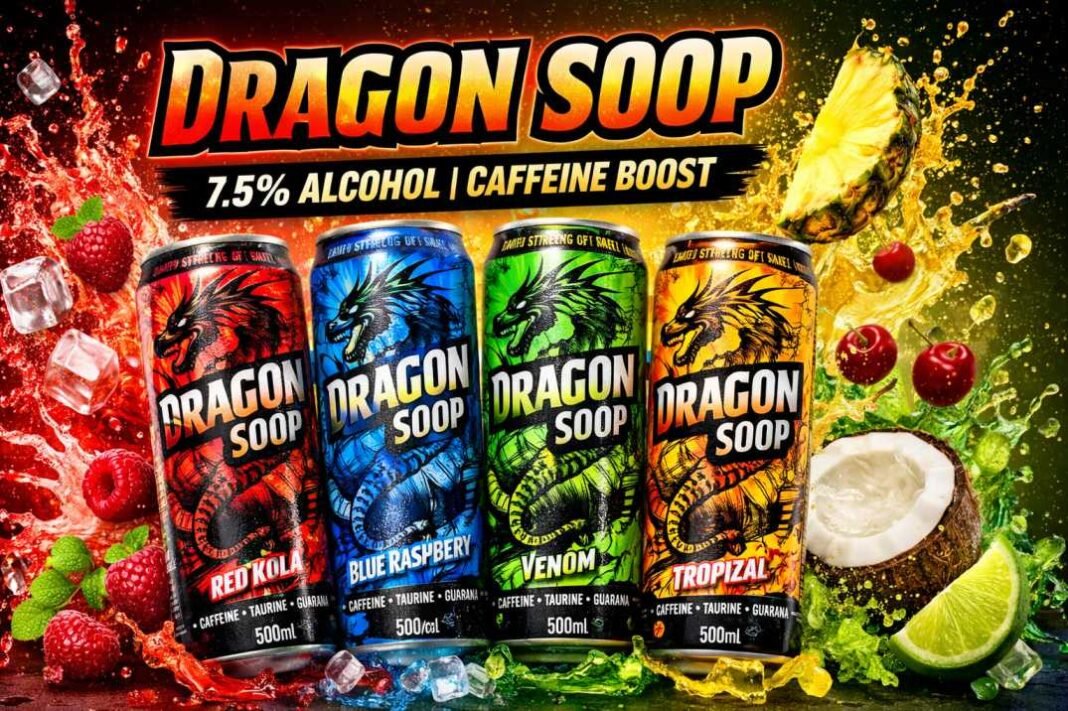

Dragon Soop is a caffeinated alcoholic drink sold in 500ml cans at 7.5% ABV. That is 3.75 units of alcohol per can, with 35mg of caffeine per 100ml alongside taurine and guarana. It is made by Corinthian Brands (CBL) Limited, and despite its reputation it has never been censured by the UK drinks regulator. Here is what is actually in the can, what the numbers mean, and what the 2022 ruling really said.
Key takeaways
- 7.5% ABV in a 500ml can — stronger than the average UK ready-to-drink.
- 3.75 units per can, around 27% of the weekly low-risk guideline.
- 35mg of caffeine per 100ml, plus taurine and guarana.
- Made by Corinthian Brands (CBL) Limited.
- The 2022 Portman Group complaints were all not upheld, with no action required.
- In Scotland minimum unit pricing sets a floor of about £2.44 a can.
It usually starts the same way. A quick stop at a corner shop on a Friday evening, shelves full of colourful cans, and your eye lands on something bold and almost electric. Dragon Soop does not look like a typical alcoholic drink, and that is precisely the point. Behind the energy-drink styling sits a drink carrying both alcohol and caffeine — a combination that attracts curiosity and caution in roughly equal measure.
What Dragon Soop Actually Is

Image source: pexels.com
Dragon Soop sits in a category of its own. It is not an energy drink, because it contains alcohol. It is not quite an alcopop either, because of the stimulants. The producer describes it as “a 7.5% abv drink containing high levels of caffeine (35mg per 100ml) blended with taurine, guarana and delicious flavours”, which is about as clear a definition as you will get. The formal term is a caffeinated alcoholic beverage. The packaging borrows its visual language from energy drinks, in the same way that Corona Pop bottles or Cobra bottles lean on a recognisable look to stand out in a crowded fridge.
Strength and Units: The Numbers That Matter
This is the part worth knowing before anything else. A 500ml can at 7.5% ABV works out at 3.75 units of alcohol. That is the producer’s own figure, confirmed in the regulator’s published decision, and it is a meaningful amount for a single container. The UK’s low-risk drinking guideline is 14 units across a whole week, so one can is a little over a quarter of that week in one sitting. For comparison, the Portman Group’s own panel noted that the average UK ready-to-drink sits at 4.6% ABV, which is roughly where you will find Camden Hells at 4.6% and well below BrewDog Punk IPA’s 5.4%.
One 500ml can = 3.75 units. The UK low-risk guideline is 14 units a week.
Units calculated as 500ml × 7.5% ÷ 1,000. Weekly guideline: NHS inform, low-risk drinking guidelines. Average RTD strength: Portman Group decision, 27 September 2022.
How Much Caffeine Is in a Can
The published figure is 35mg of caffeine per 100ml, which the producer states and which also appears on the back of the can. Multiply that by five for a 500ml can and you get roughly 175mg. It is worth being precise about where that number comes from: 175mg is arithmetic, not a published figure, and you will see it quoted all over the internet as though the brand had stated it. For scale, that is in the same territory as a large energy drink — our guide to how much caffeine is in a Monster puts a 500ml can at 160mg. The difference here is that the caffeine arrives alongside 3.75 units of alcohol rather than on its own.
| Product | Can size | ABV | Units | Caffeine |
|---|---|---|---|---|
| Dragon Soop | 500ml | 7.5% | 3.75 | 35mg per 100ml |
| Dragon Soop X | 440ml | 12% | 5.28 | None — caffeine free |
| Dragon Soop Vodka Ice | Not published | 3.4% | Depends on size | Contains caffeine |
Source: Corinthian Brands, Dragon Soop product page. Unit figures are our own calculation from the published ABV and can size.
The Full Range: Dragon Soop, X and Vodka Ice
Image source: pexels.com
Most write-ups stop at the 7.5% can, which misses two products that behave very differently. Dragon Soop X comes in a 440ml resealable can, is vodka based, and is 12% ABV and caffeine free — the opposite of what people assume from the name. At that strength it carries 5.28 units in a single can, which is above the four-unit level the regulator treats as the sensible ceiling for a single-serve container. Dragon Soop Vodka Ice goes the other way at 3.4% ABV, made with vodka and still containing caffeine, taurine and guarana. If someone hands you a Dragon Soop, it is worth checking which one it is.
Strengths as published by Corinthian Brands. Average UK ready-to-drink strength from the Portman Group decision.
Flavours, and Why the Lists Disagree

Image source: pixabay.com
The flavour range rotates, and the two official sources do not quite agree, which is worth knowing before you trust any list. Both the brand site and the producer site name eleven flavours, and nine appear on both: Blueberry & Guava, Blue Pineapple & Kiwi, Blue Raspberry, Dark Fruit Punch, Mango Pink Lemonade, Peach & Raspberry, Red Kola, Strawberry & Lime, Venom and Wild Cherry. The brand site adds Spiced Pineapple; the producer site lists Red Fruits instead. Retailers stock older flavours such as Apple & Blackcurrant and Wicked Watermelon too. Treat any flavour list, including this one, as a snapshot rather than a fixed menu, much as Magners bottles rotate their range.
Who Makes Dragon Soop
Dragon Soop is produced by Corinthian Brands (CBL) Limited. This is worth stating plainly because several articles name the wrong company, and the regulator’s decision records Corinthian Brands as the producer throughout. It is a UK drinks business rather than a global brewer, which partly explains why the brand behaves differently from the big lager names covered in our comparisons of Cobra and Kingfisher and Magners and Strongbow.
What the Portman Group Ruling Actually Said
Image source: pexels.com
Here is the part the internet gets wrong. In 2022 the Portman Group, which runs the UK code of practice on alcohol marketing, considered two complaints about Dragon Soop Wicked Watermelon — one from a member of the public and one from the Northern Ireland Alcohol and Drugs Alliance. The complaints covered packaging, strength, appeal to under-18s and anti-social behaviour. Every single rule was found not upheld, and the published outcome records “Action by company: None required.” The drink was not banned, not censured and not reformulated as a result.
| Code rule | What it covers | Panel decision |
|---|---|---|
| 3.1 | Alcoholic nature communicated with absolute clarity | Not upheld |
| 3.2(a) | Undue emphasis on strength or intoxicating effect | Not upheld |
| 3.2(b) | Association with bravado or anti-social behaviour | Not upheld |
| 3.2(f) | Encouraging irresponsible or immoderate drinking | Not upheld |
| 3.2(h) | Particular appeal to under-18s | Not upheld |
| 3.2(j) | Suggesting the drink enhances capability or changes mood | Not upheld |
Source: Portman Group Independent Complaints Panel, Dragon Soop Wicked Watermelon, 27 September 2022.
Two details from the decision are worth carrying away. On appeal to young people, the panel concluded that “while the product may have a broad appeal, it did not have a particular appeal to under-18s”. On strength, it noted that the can contains 3.75 units and that this sits below the four units the Portman Group recommends as the maximum in a single-serve container. The panel also corrected a factual error in one complaint, which had claimed the drink was 8% ABV and four units. It is not. Importantly, the panel was explicit about its own limits: alcoholic energy drinks are legal in the UK, and the health effects of combining caffeine with alcohol were outside what the code could consider. A clean ruling on marketing is not a clean bill of health.
Price, and the Scottish Floor
Retail prices move constantly, so any figure quoted here would be wrong within months. In Scotland, though, there is a legal minimum you can work out exactly. Minimum unit pricing has been set at 65p per unit since 30 September 2024, and the price floor is calculated by multiplying the price per unit by the ABV and the volume in litres, rounded up to the nearest penny. For a 500ml can of Dragon Soop that is 0.65 × 7.5 × 0.5, giving a legal minimum of £2.44. A 440ml can of Dragon Soop X at 12% works out at £3.44. No Scottish retailer can sell below those figures, whatever the offer.
Rate: Scottish Government, minimum unit pricing. Calculation method: mygov.scot. Floor prices are our own calculation using that formula.
Drinking It Sensibly
The practical issue with caffeinated alcohol is not mystery chemistry, it is that stimulants can make you feel more alert than you are. You may feel wide awake while your body processes the alcohol at exactly the same rate as it would without the caffeine, which makes it easier to misjudge how much you have had. The UK low-risk guideline is no more than 14 units a week, spread over three or more days, and official guidance is clear that there is no completely safe level of drinking. One can is 3.75 of those units. Dragon Soop is sold to over-18s only, and the sweetness is genuinely good at hiding the strength.
Source: NHS inform, low-risk drinking guidelines.
Final Thoughts
Strip away the noise and Dragon Soop is a straightforward thing: a 7.5% caffeinated alcoholic drink in a 500ml can, carrying 3.75 units and about 175mg of caffeine, made by Corinthian Brands and cleared by the drinks regulator on every complaint brought against it. What it is not is a soft drink, and the can is designed in a way that makes that easy to forget. Check which variant you have, count it as nearly four units rather than one drink, and you know where you stand.
Frequently Asked Questions
What is Dragon Soop?
A caffeinated alcoholic beverage sold in 500ml cans at 7.5% ABV, containing caffeine, taurine and guarana. It is made by Corinthian Brands (CBL) Limited.
How strong is Dragon Soop?
The main range is 7.5% ABV. Dragon Soop X is 12% ABV in a 440ml can, and Dragon Soop Vodka Ice is 3.4% ABV.
How many units are in a can of Dragon Soop?
3.75 units in a 500ml can at 7.5% ABV. That is roughly 27% of the UK low-risk weekly guideline of 14 units in a single can.
How much caffeine is in Dragon Soop?
The published figure is 35mg per 100ml, which works out at about 175mg in a 500ml can. Dragon Soop X is caffeine free.
Who makes Dragon Soop?
Corinthian Brands (CBL) Limited. Several articles name the wrong company; the regulator’s own decision records Corinthian Brands as the producer.
Was Dragon Soop banned or censured?
No. The Portman Group considered two complaints in 2022 and found every rule not upheld, with no action required from the company.
How much does Dragon Soop cost in Scotland?
Minimum unit pricing sets a legal floor of about £2.44 for a 500ml can, based on 65p per unit since 30 September 2024.
Disclaimer
This article is for general information only and is not medical advice. Alcohol is sold to over-18s in the UK; please drink responsibly. Product specifications, flavours and prices change, so always check the label on the can you have bought. Figures quoted reflect published producer and regulator information as of 30 October 2026.
Last updated: 30 October 2026