
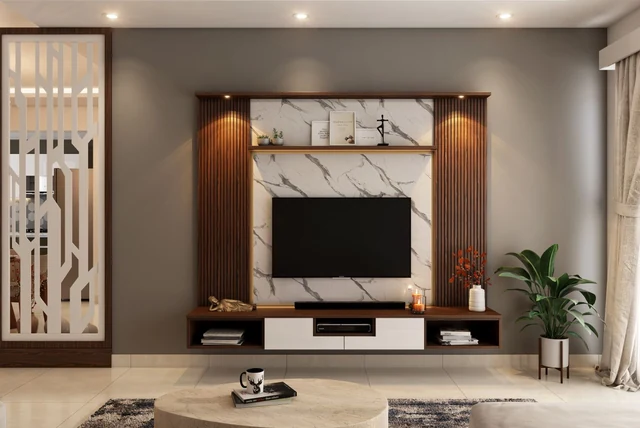

A media wall is a built-out or fitted wall that holds your TV, storage, lighting, cables and, often, an electric fire. In the UK, most fitted media walls cost about £2,000 to £4,500. Simple builds start near £1,200, and statement walls can pass £10,000. This guide gives you 20 media wall ideas for UK homes, plus costs, TV sizing, safety rules and the mistakes to avoid.
Quick answer: media wall ideas and costs in the UK
- Typical fitted cost: about £2,000 to £4,500 (indicative, Trade2Base June 2026 and MyBuilder August 2026).
- Basic build: from about £1,200 to £2,500 for a stud wall with a standard inset electric fire.
- Statement wall: £5,000 to £10,000 or more, with a three-sided fire and a premium finish.
- TV height: centre of the screen at seated eye level, usually 100cm to 110cm from the floor.
- Electrics: use a registered electrician for new sockets and the fire’s supply.
- No building work? Wall-hung units, console tables and modular shelving give a similar look.
This guide is based on published guidance, UK price guides and expert sources, checked on 13 October 2026. Prices are indicative, so get at least three quotes before you commit.
What’s in this guide
- What is a media wall?
- Which media wall suits your room?
- 20 media wall ideas for UK homes
- Colours and finishes
- Lighting ideas
- How much does a media wall cost in the UK?
- DIY or hire a professional?
- How to plan a media wall
- Safety and rules to check
- Common mistakes to avoid
- Media wall trends for 2026
- FAQs
What is a media wall?
A media wall brings your TV, storage, lighting, cables and often a fire into one tidy feature. It stops the TV looking like an afterthought in the corner, and it hides the leads and boxes that clutter a room. If you like a clean, modern living room, it is one of the easiest ways to get there.
There are three main types:
- Built stud wall: a timber or metal frame, boarded and painted, with a TV recess and often an inset electric fire.
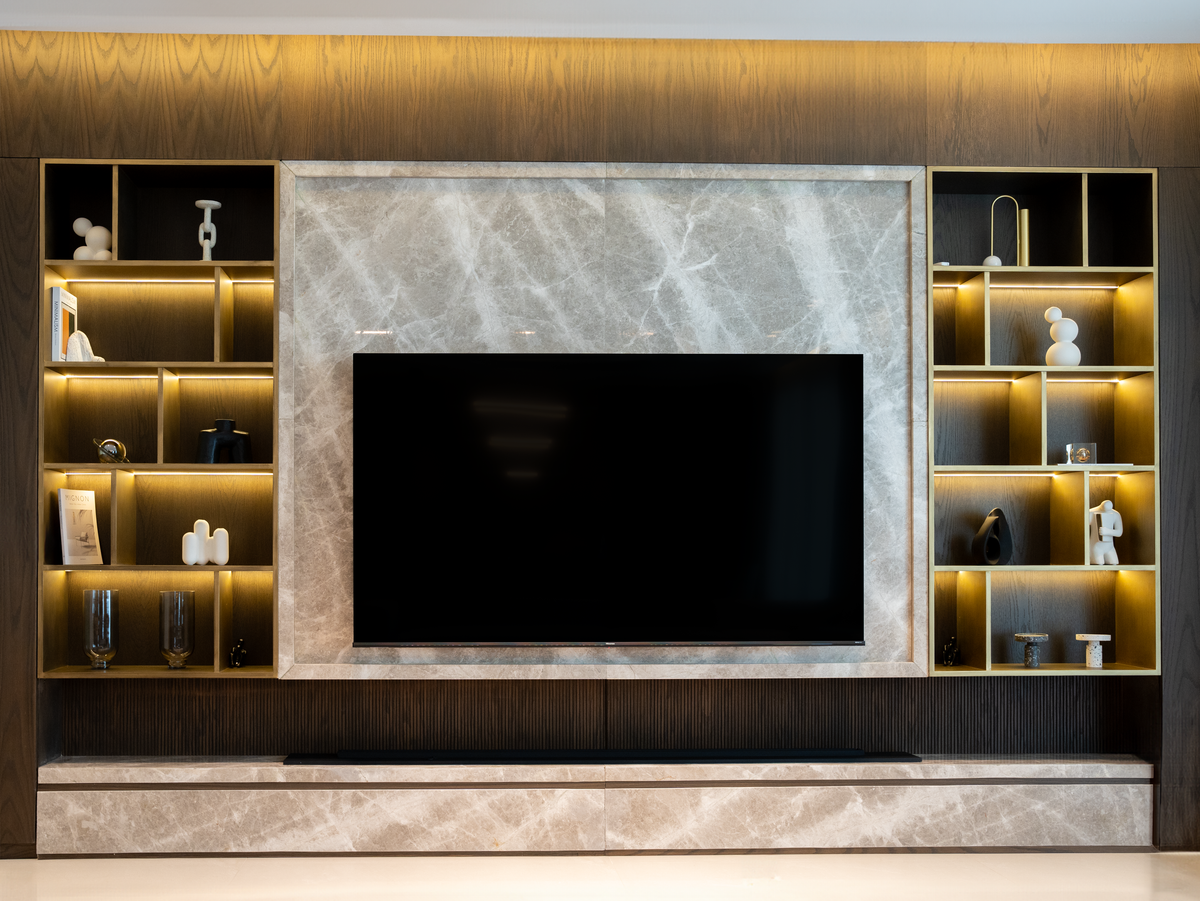
- Fitted furniture units: made-to-measure cabinets and shelves arranged around the TV.
- No-build version: wall-hung and freestanding pieces that create the same look without building work.
Which media wall suits your room?
Use this table to find the style that fits your room, budget and skill level. Costs come from the sources named in each section below and are indicative.
| Style | Best for | Typical budget | DIY level |
|---|---|---|---|
| Fire-led | Cosy living rooms, family homes | £1,200 to £4,500+ | Medium to pro (electrician needed) |
| Small room | Compact lounges, flats | From a tin of paint to £2,500 | Easy to medium |
| Slat or panel feature | Open plan, echoey rooms, a bold look | Materials from £10 per sheet or £10 to £100 per m² | Easy to medium |
| Storage-led | Families, clutter, chimney breast alcoves | Shelving £200 to £1,000 | Medium |
| No-build or renter-friendly | Rented homes, flexible spaces | Not publicly confirmed | Easy |
| Bedroom | Bedrooms with limited floor space | Not publicly confirmed | Medium |
| Statement or luxury | Large rooms, full-height walls | £5,000 to £10,000+ | Pro |
20 media wall ideas for UK homes
The ideas are grouped by style. Where a cost is shown, it comes from a named UK source and is indicative. Where no cost is shown, no reliable figure was publicly available.
Fire-led media wall ideas
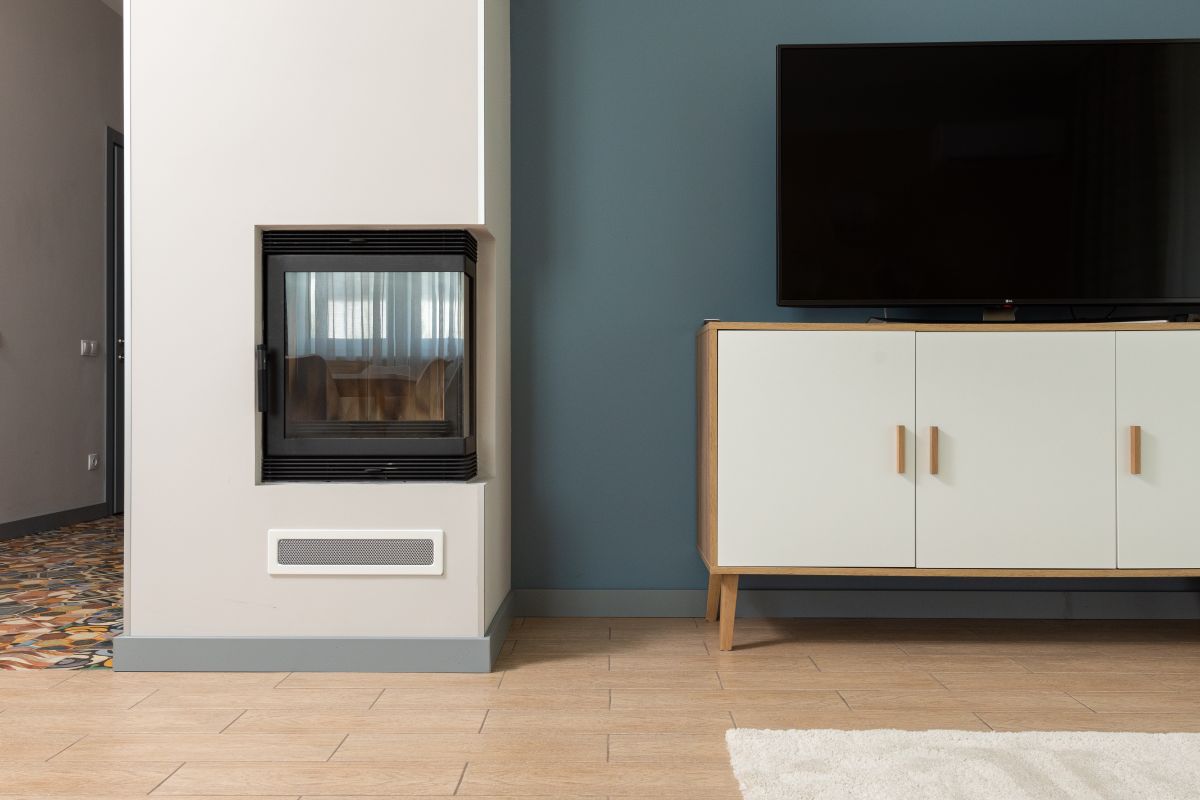
1. Slimline inset electric fire on a stud wall
This is the classic media wall: a stud wall with a recessed electric fire under a wall-mounted TV. A basic build costs about £1,200 to £2,500, according to Trade2Base (June 2026). Choose the fire first, because its size decides how deep you build. Retailer Simply Stoves says most electric media wall fires need 150mm to 300mm of depth, depending on the model. Slimline fires suit smaller rooms where depth is tight. Check the walkway before you start, as a deeper wall takes floor space.
2. Panoramic or three-sided fire statement wall
Wider and glass-sided fires create a dramatic glow. Trade2Base puts panoramic fires at £500 to £1,000, and two- or three-sided fires at £800 to £2,500 or more. This idea suits larger rooms where the wall is wide enough to carry the fire without looking crowded. The fire is often the biggest single cost after labour, so agree the exact model, and who is buying it, before you collect quotes.
3. Wall-hung electric fire under a floating TV
If you don’t want a recess, a wall-hung electric fire sits on the wall with the TV above. It is quicker to fit and works well on a flat wall. Heat leaves from the top of many fires, so leave space and never block the heat outlet. One UK retailer’s installation advice says the temperature around the TV must stay within the TV maker’s limits. Always read both the fire manual and the TV manual.
4. Chimney breast conversion
Many people in period homes turn an old fireplace into a media wall, with the TV above an inset electric fire. It keeps the character of the room and avoids building a new wall. Be careful if the plan involves removing or building out the chimney breast. Trade2Base says this can need a structural engineer and building control sign-off if it affects support above, and it can add several hundred to a couple of thousand pounds.
Small living room media wall ideas
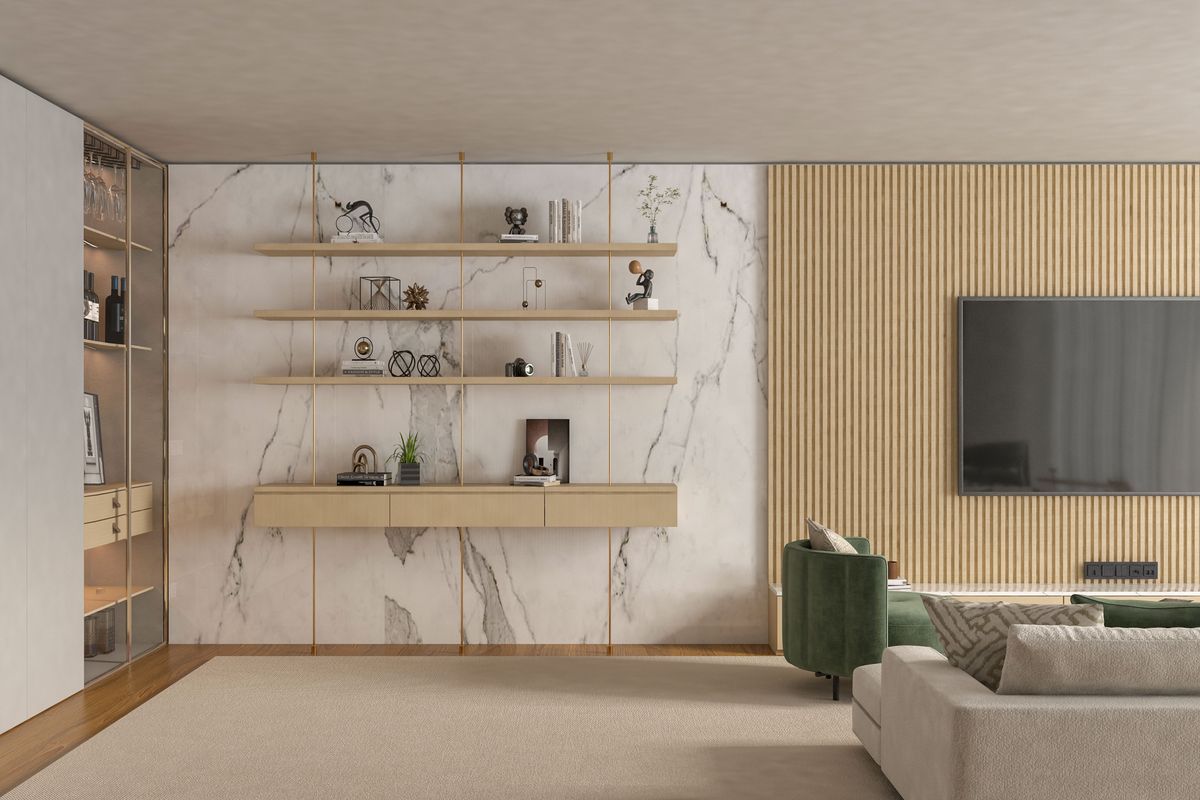
5. Slim floating panel with a low cabinet
Magnet describes this as a minimalist option: a mounted TV with concealed storage beneath. The panel sits close to the wall, so it keeps most of your floor space. Hide the boxes and games consoles in the cabinet and the wall stays calm. It is a good match with ideas from our guide to small living room TV unit ideas.
6. Corner media wall
An awkward layout can make a straight media wall hard to fit. A corner media wall, sometimes with an angled fire, uses space that would otherwise go to waste. Installer Media Wall Master suggests it for rooms with tricky layouts. Check the fire manual for how close the fire can sit to the corner, and make sure everyone can see the screen from the sofa.
7. Narrow vertical storage beside the TV
Tall, thin shelves or cupboards frame the TV without boxing it in. Dako Furniture describes thin framing, floating panels and narrow vertical storage as the small-room approach. Use the shelves for books and a plant or two, and keep the middle clear so the screen is the focus. This idea also fits a simple small living room layout.
8. Painted dark wall behind the TV
You don’t have to build anything to get a media wall look. Paint the wall behind the TV in a deep colour, mount the TV and add a low unit below. Magnet says a darker wall helps the screen blend in, and that matt finishes cut reflections. British Fires also lists darker palettes as a 2026 direction. Keep the paint matt and test a sample at night.
Texture and finish ideas
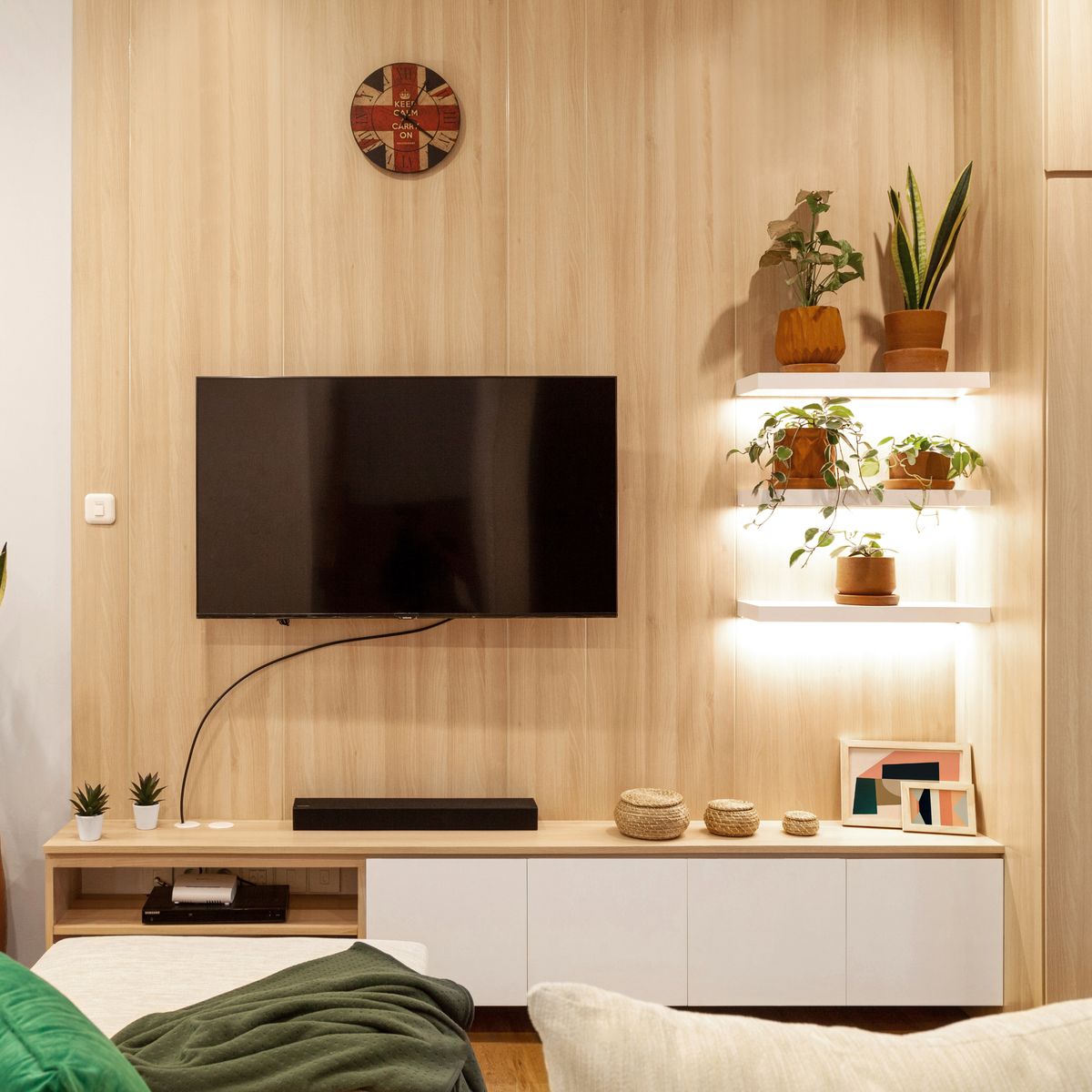
9. Slatted or acoustic panel wall
A slat media wall uses vertical timber or timber-effect panels behind the TV. Homebuilding says acoustic panels can reduce echo in rooms with lots of hard surfaces. MyBuilder puts cladding at £10 to £100 per m², a wide range that depends on design and material. Price your exact panel type before you decide, because the finish is where costs creep up.
10. Fluted or ribbed MDF panelling
Fluted and ribbed panels add texture and catch the light. A panel maker quoted by Homebuilding says most MDF wall panels can be painted to match your colour scheme. MDF costs £10 to £25 a sheet, says MyBuilder, though it is less durable than premium materials. It works well inside alcoves or behind a unit, and it is one of the easier finishes to fit yourself.
11. Wallpaper behind the TV
If you want a feature wall without committing to a whole surface, add wallpaper inside the media wall, behind the TV. An interior designer quoted by Homebuilding says the wallpaper should quietly lift the room rather than compete with the screen. Look at it in daylight and in the evening, because the TV becomes the main light source after dark.
12. Microcement, stone or porcelain statement finish
For a high-end look, builders use microcement, stone effect or porcelain around the fire and TV. Trade2Base says microcement needs an experienced applicator and several coats. MyBuilder says hardwood and stone start from £50 per m², and heavier materials can need more skilled labour. This finish is the main reason a statement wall reaches the £5,000 to £10,000 tier.
Storage-led media wall ideas
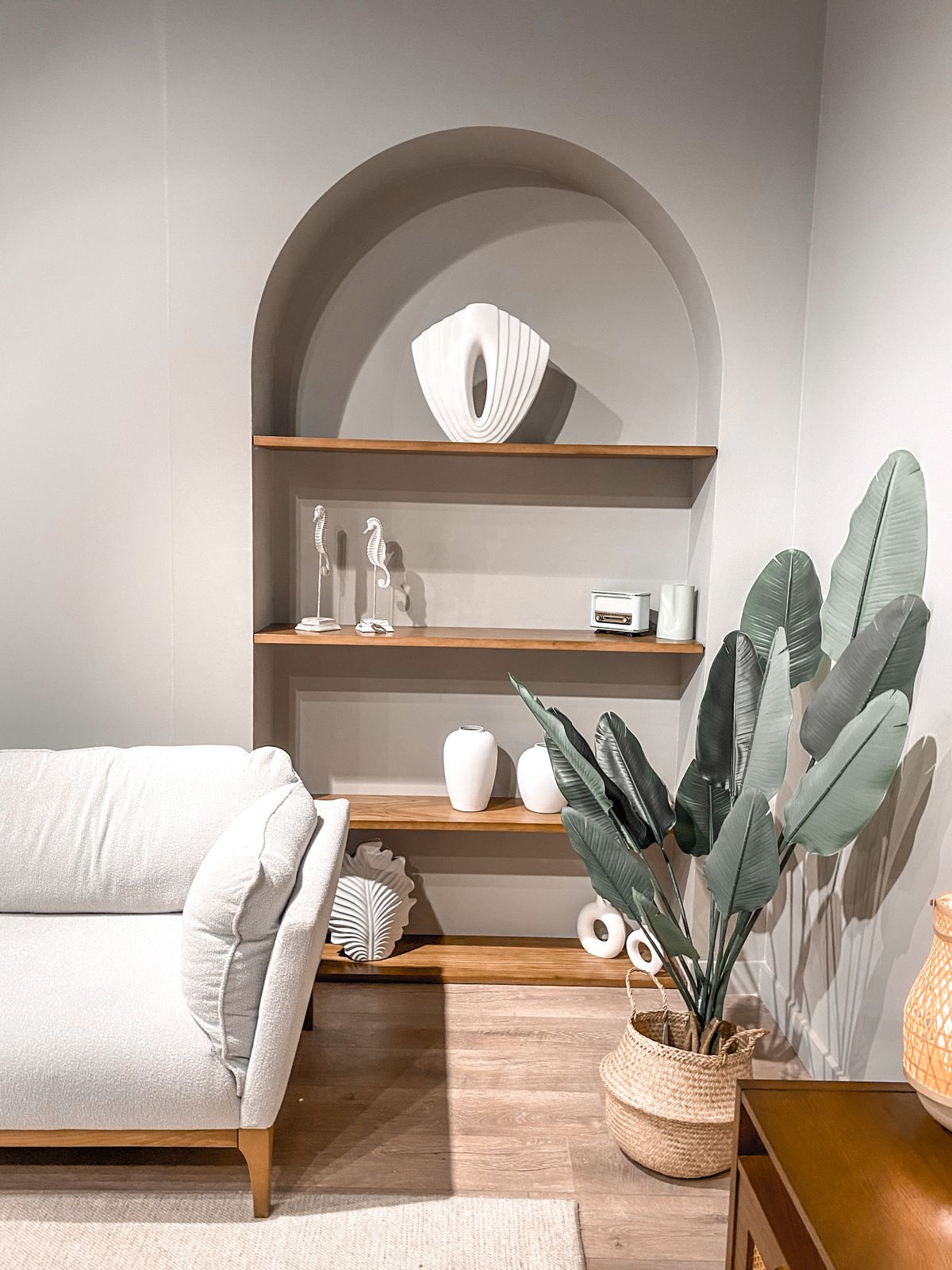
13. Alcove shelving and cabinets around a chimney breast
If your room has a chimney breast, put the TV in the middle and fill the alcoves with shelves and cupboards. Magnet says bespoke cabinets in alcoves can look original to the house. MyBuilder gives custom shelving at £200 to £1,000. For more ways to hide clutter, see these living room storage ideas.
14. A mix of open and closed storage
Open shelves show off books, art and plants. Closed cupboards hide consoles, streaming boxes and remotes. Magnet says combining the two gives the most flexibility. Homebuilding notes that open shelving helps a small room feel less crowded. A simple rule: closed storage low down, open shelves at the sides and above.
15. Hideaway or sliding doors
Doors let you hide the TV completely when it’s off. Homebuilding gives the main warnings. Plan your seating so an open door never blocks the view, and make sure the doors stay open instead of swinging shut. Check airflow too, because equipment behind closed doors needs ventilation.
16. Bookcase media wall
Brand VonHaus suggests combining shelving for books and films with the TV in the middle. It suits anyone with a big collection. Books are heavy, so build strong shelves and fix them properly. Mix in a few objects and plants so the wall doesn’t look like a library with a screen stuck in the middle.
No-build and renter-friendly ideas
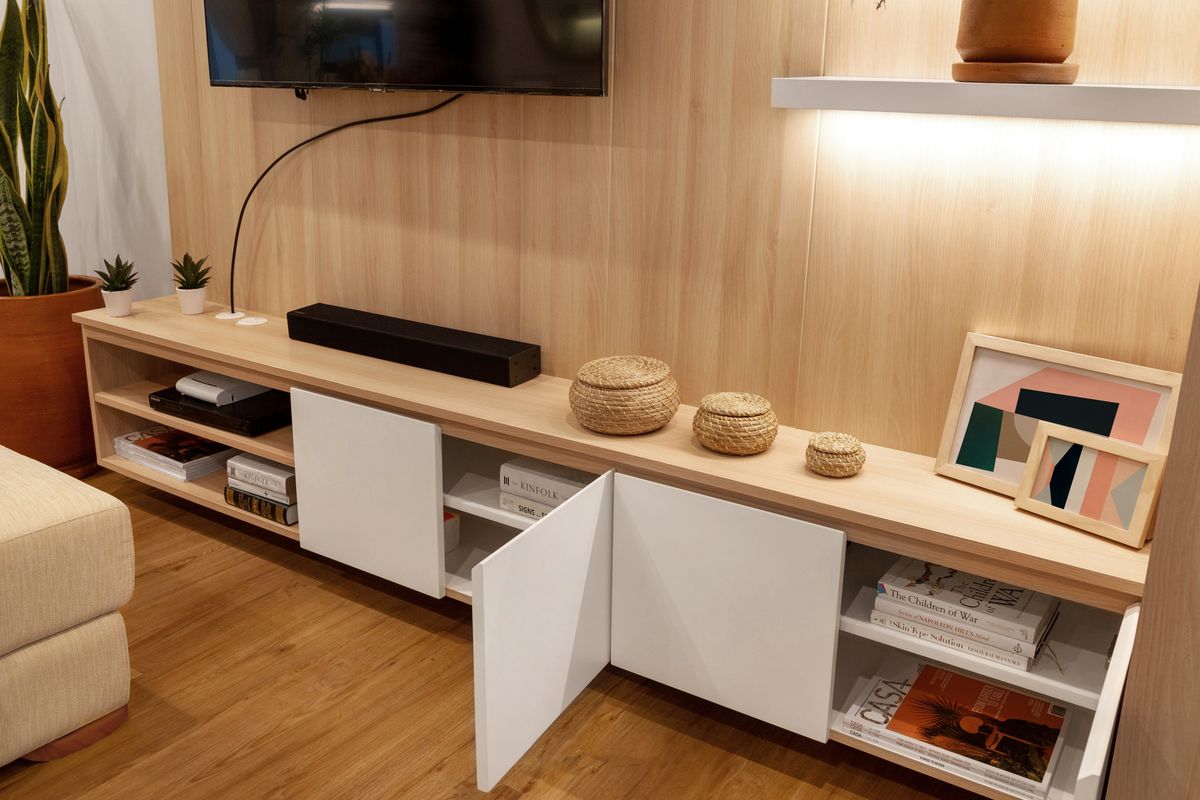
17. Wall-hung units plus freestanding pieces
Furniture retailer Storia (August 2026) says wall-hung units can frame the media area and create the effect of a larger media wall without filling the whole wall. Freestanding pieces can be moved or restyled later. Matching display cabinets and shelves to your multifunctional living room furniture keeps the room flexible.
18. Console table with a gallery wall
Real Homes suggests a console table with storage to give a media wall effect. Add a gallery wall of prints and photos around the TV for a more contemporary look. The cables will show unless you plan them, so use cable clips or trunking to keep them tidy.
19. Modular open shelving
Modular shelving can stand alone to create a media wall feel, as shown by Real Homes. Magnet adds that modular systems are built from separate parts you can rearrange. Open shelves show clutter, so choose a few baskets or boxes. If you rent, check your lease or ask your landlord before drilling into walls. This idea also pairs well with rental home decor ideas.
Bedroom media wall idea
20. Bedroom media wall with soft lighting and storage
Spaceslide describes a bedroom media wall as a space-saving way to bring storage and a screen into one place. Soft lighting and sleek finishes help it feel like a hotel room rather than a living room. Use warm lighting ideas for a bedroom to set the mood, and take cues from contemporary bedroom ideas for the finish. Keep the TV out of line of sight from the bed if you want the room to feel restful.
All 20 ideas at a glance
| # | Idea | Style | Cost (where sourced) | DIY level |
|---|---|---|---|---|
| 1 | Slimline inset fire on a stud wall | Fire-led | £1,200 to £2,500 (whole wall) | Medium |
| 2 | Panoramic or three-sided fire | Statement | Fire £500 to £2,500+ | Pro |
| 3 | Wall-hung fire under a floating TV | Fire-led | Not publicly confirmed | Medium |
| 4 | Chimney breast conversion | Fire-led | Not publicly confirmed | Pro |
| 5 | Slim floating panel and low cabinet | Small room | Not publicly confirmed | Medium |
| 6 | Corner media wall | Small room | Not publicly confirmed | Medium |
| 7 | Narrow vertical storage | Small room | Shelving £200 to £1,000 | Medium |
| 8 | Painted dark wall | Small room | Not publicly confirmed | Easy |
| 9 | Slatted or acoustic panels | Texture | Cladding £10 to £100 per m² | Easy to medium |
| 10 | Fluted or ribbed MDF | Texture | MDF £10 to £25 per sheet | Easy |
| 11 | Wallpaper behind the TV | Texture | Not publicly confirmed | Easy |
| 12 | Microcement, stone or porcelain | Statement | Stone and hardwood from £50 per m² | Pro |
| 13 | Alcove shelving and cabinets | Storage-led | £200 to £1,000 | Medium |
| 14 | Open and closed storage mix | Storage-led | Not publicly confirmed | Medium |
| 15 | Hideaway or sliding doors | Storage-led | Not publicly confirmed | Pro |
| 16 | Bookcase media wall | Storage-led | Not publicly confirmed | Medium |
| 17 | Wall-hung and freestanding units | No-build | Not publicly confirmed | Easy |
| 18 | Console table and gallery wall | No-build | Not publicly confirmed | Easy |
| 19 | Modular open shelving | No-build | Not publicly confirmed | Easy |
| 20 | Bedroom media wall | Bedroom | Not publicly confirmed | Medium |
Media wall colours and finishes
The screen is a big black rectangle when it’s off, so your colours matter. Here is what the sources suggest:
- Go matt: Magnet says matt finishes around the TV reduce reflections. Lawcris, a board maker, calls gloss a red flag for media walls.
- Go darker for a cinema feel: Magnet says darker walls behind the TV help the screen recede when it’s off.
- Go light in small rooms: Media Wall Master suggests white, beige or soft grey to keep a compact room airy.
- Use contrast: Spaceslide suggests deep navy or charcoal units against lighter walls for a bold feature.
- Try muted greens: Lawcris names smoke green and taupe grey among its popular matt finishes.
Test paint and wallpaper at night, because the TV becomes the main light in the room. For more colour inspiration, browse our living room colour ideas, our grey living room ideas and our guide to an olive green living room.
Media wall lighting ideas
Good lighting makes a media wall feel finished, and it also makes the screen easier to watch. Magnet recommends layers:
- Bias lighting: LED strips behind the TV, which Magnet says reduce eye strain and give a floating look.
- Downlights: recessed lights for general light and to show off wall texture.
- Shelf lighting: soft light on books and objects.
- Dimmers: so the room works for daytime, guests and film nights.
Warm white light between 2700K and 3000K is the most comfortable for living rooms, says Magnet. Keep it subtle: a designer quoted by Homebuilding says the best media wall lighting works in the background instead of competing with the TV. MyBuilder puts lighting at £30 to £800, depending on the type and how complex it is.
For more ideas, see our guides to ambient lighting for a living room, smart lighting ideas and wall lights for the living room.
How much does a media wall cost in the UK?
Most fitted media walls cost about £2,000 to £4,500. The exact price depends on wall size, the fire, the finish, the electrics and where you live. The two UK price guides we found do not agree exactly, so both are shown below. All figures are indicative and were checked on 13 October 2026.
| Level | Typical cost | What you usually get |
|---|---|---|
| Basic | £1,200 to £2,500 | Stud wall, standard inset fire recess, TV zone, painted finish, basic sockets |
| Mid-range | £2,500 to £4,500 | Panoramic fire, TV recess with cable management, downlights and LEDs, panelling, shelving |
| High-end | £5,000 to £10,000+ | Large inset fire, slatted or fluted feature, integrated AV, microcement or stone finish |
UK media wall cost ranges (£, indicative, 2026)
Sources: Trade2Base (Jun 2026) and MyBuilder (Aug 2026)
Labour and materials
A media wall usually needs a carpenter, an electrician and often a plasterer. Trade2Base says a typical build takes three to six days across the trades. Day rates are higher in London and the South East.
| Item | Indicative price | Source |
|---|---|---|
| Carpenter or joiner | £150 to £350 per day (MyBuilder); £200 to £300 (Trade2Base) | 2026 |
| Electrician | £40 to £90 per hour (MyBuilder); £200 to £300 per day (Trade2Base) | 2026 |
| Plasterer | £150 to £300 per day (MyBuilder); £180 to £250 (Trade2Base) | 2026 |
| False wall including plaster and electrics | £55 to £65 per m² | MyBuilder |
| MDF sheet | £10 to £25 | MyBuilder |
| Plywood sheet | £15 to £30 | MyBuilder |
| Cladding | £10 to £100 per m² | MyBuilder |
| Custom shelving | £200 to £1,000 | MyBuilder |
| Lighting (LED strips, accent) | £30 to £800 | MyBuilder |
| Standard inset electric fire | £200 to £500 | Trade2Base |
| Panoramic inset fire | £500 to £1,000 | Trade2Base |
| Two- or three-sided fire | £800 to £2,500+ | Trade2Base |
| TV wall mounting (outside London) | £60 to £120; £90 to £200 in London and the South East | Fantastic Services, 2026 |
Worked example: a 3m mid-range media wall
Trade2Base gives a worked example of a 3m wall with a panoramic fire, TV recess, fluted feature, downlights, LED strip and two floating shelves. The costs add up to about £2,980. After overheads and margin, the customer price lands around £3,500 to £4,200. A three-sided fire and microcement finish would push the same wall towards £5,500 or more.
- Carpenter: £750 (25%)
- Panoramic fire: £750 (25%)
- Timber, board, skim, fixings: £350 (12%)
- Plasterer: £330 (11%)
- Fluted panels and paint: £250 (8%)
- Electrician: £250 (8%)
- Lights, driver, dimmer: £180 (6%)
- Shelf materials and brackets: £120 (4%)
Source: Trade2Base, 14 June 2026. Indicative worked example for tradespeople, not a quote.
What pushes the price up
- The fire: the biggest single variable after labour. Agree the model first.
- Wall size: a small room might need a 2.4m wall, while an open-plan space can need 4m or more and full height.
- The finish: painted MDF is cheapest. Fluted panels, slats, microcement and stone cost more.
- Electrics: extra sockets, a spur for the fire, hidden cables and any new circuit.
- Chimney breast work: building out or removing it can add days and cost.
- Location: London and the South East are usually higher. Fantastic Services puts TV mounting 15% to 30% higher there.
On a tight budget, start with the finish and the lighting, which are easier to upgrade later than the structure. Our guide to budget home decor ideas has more ways to save.
DIY or hire a professional?
If you can build a stud wall, you can build a simple media wall. Gr8fires, a fire retailer, says this, and Toolstore says confident DIYers with basic carpentry can manage simpler designs without fireplaces or cupboards. The electrics are different. Homebuilding says that even for a DIY wall, the hard-wired electrical set-up should be done by an electrician.
| Factor | DIY | Fitted by trades |
|---|---|---|
| Cost | Materials only (MDF £10 to £25 per sheet). Fire £200 to £2,500+. | Labour £1,500 to £3,500 (MyBuilder), within a whole-wall range of about £2,000 to £4,500 |
| Time | Not publicly confirmed | 3 to 6 days across the trades (Trade2Base) |
| Skill | Basic carpentry and finishing, plus patience with plastering | Carpenter, electrician and often a plasterer |
| Electrics | Registered electrician needed for sockets and the fire’s supply | Included in the job |
| Main risks | Wrong depth, no ventilation, TV too high, rushed finishing | A loose quote: who supplies the fire and TV, which finish, who handles Part P |
| Middle option | Ready-made media wall suites and kits | Made-to-measure furniture units |
If you hire, write down the exact fire model, the TV size, the finish and the electrical work in the quote. Trade2Base says vague quotes are the main reason jobs go over budget.
How to plan a media wall
Choose your TV size and viewing distance
Experts disagree on the best seating distance, so treat the figures below as a range. Which? asks a panel of viewers and suggests the longest distances. Retailer Vebos suggests shorter ones. Hisense uses a simple rule: sit 1.5 to 2.5 times the screen size away. Hisense and Vebos both say 4K lets you sit closer than older HD sets.
| TV size | Which? best distance | Vebos range | Rule of thumb (1.5 to 2.5 × screen size) |
|---|---|---|---|
| 55 inch | 3.4m to 3.7m | 2.1m to 2.5m | About 2.1m to 3.5m |
| 65 inch | 4m | 2.5m to 3m | About 2.5m to 4.1m |
| 75 inch | 4.6m | 2.9m to 3.4m | About 2.9m to 4.8m |
Recommended viewing distance by TV size (metres)
Sources: Which?, Vebos, Hisense UK. Sources disagree, so use the overlap as a guide.
Which? gives a single best distance, shown as a thin marker.
Measure from where you actually sit, not the edge of the sofa. Which? suggests measuring from the back cushion. Plan your seating alongside the wall using our furniture placement guide.
Get the TV height right
Put the centre of the screen at seated eye level. Magnet says this is typically 100cm to 110cm from the floor. Homebuilding warns that mounting the TV too high causes neck strain and a distorted picture. A TV above a fire often ends up too high, so check the height before you fix the fire position.
Decide depth and framing
Magnet says a stud wall, made from timber or metal, is the most common method. It leaves room for cables, recesses and storage. Direct cladding suits walls where you only need a little depth. Online Bedrooms suggests building against a masonry wall where possible, for a stronger fixing. Choose the fire and the TV first, then build to their sizes. Leave extra room around the TV so you can upgrade later, rather than building tightly around today’s screen.
Plan sockets, ethernet and cables
Trade2Base says most media walls need extra sockets behind the TV and at shelf height, plus a fused spur for the electric fire. Homebuilding adds that you should fit more sockets and ethernet points than you think you need, as you won’t get another chance once the wall is decorated. Magnet suggests installing conduit so you can run new cables later without opening the wall.
Original diagram: what to plan before the wall is closed up.
Allow for ventilation and access
Consoles, TV boxes and amplifiers get hot. Homebuilding and Magnet both say to allow airflow, especially inside closed cabinets. Trade2Base says don’t seal AV kit in an airtight void. Homebuilding also advises keeping access to the back of the TV, so a repair doesn’t mean taking the plasterboard off.
Safety and rules to check
These points are for guidance only. Ask a qualified professional about your own home, and check your local rules before starting.
- Electrics: in England, electrical work in homes is covered by Part P of the Building Regulations. Some work must be notified, or certified by a registered competent person. Read the Planning Portal guide to Part P and use a registered electrician. Wales, Scotland and Northern Ireland have their own building rules.
- Gas fires: only a Gas Safe registered engineer can legally install or repair a gas fire. Always ask to see their ID card, and use the Gas Safe Register to check. Magnet also notes that gas and bioethanol fires need extra ventilation and safety care.
- Heat from the fire: follow the fire maker’s clearance instructions and your TV maker’s temperature limits. There is no single safe distance that suits every fire, so don’t rely on a rule from a blog.
- Fixing a heavy TV: brick or block walls are quick to fix to. A stud wall needs the bracket bolted into timber, and plasterboard alone may need special fixings or a supporting batten, says Fantastic Services. Ask a professional if you are unsure.
- Chimney breast and structural changes: removing or building out a chimney breast may need a structural engineer and building control sign-off.
- Fire-rated board: Trade2Base says to use fire-rated board around the fire where the manufacturer requires it.
Common media wall mistakes to avoid
| Mistake | Why it matters |
|---|---|
| Mounting the TV too high | Causes neck strain and a poorer picture |
| No ventilation for AV kit | Consoles and boxes overheat |
| Too few sockets and ethernet points | You can’t add them easily once the wall is finished |
| Making the wall too shallow | Limits future TV upgrades and makes fitting awkward |
| Building tightly around today’s TV | A bigger TV later won’t fit |
| No access behind the wall | A repair could mean removing plasterboard |
| Door swing blocking the screen | Hideaway doors that close or block the view are annoying every day |
| TV too close to the fire | Heat can affect the TV, so follow both manuals |
| Rushing plastering and decorating | Spoils an otherwise good build |
| Buying the fire after building the wall | Every fire has different cut-out sizes |
It’s easy to slip on the finishing details, so take a look at our list of living room decor mistakes before you start decorating.
Media wall trends for 2026
- Darker, moodier colours: British Fires says 2026 living rooms are moving to darker palettes, and suggests offsetting the black screen with other strong features.
- More closed storage: British Fires says storage is becoming more considered and more closed.
- Less symmetry: Lawcris says media walls are moving away from strict symmetry, with asymmetric shelving and materials like marble.
- Space for bigger TVs: Online Bedrooms says walls are now planned with upgrade space, as large TVs become the default.
- Disguised screens: Homebuilding highlights art-style TVs and hideaway doors.
- No-build looks: Storia (August 2026) points to wall-hung and freestanding pieces as a lighter alternative to a full fitted wall.
- Electric fire as a feature: Trade2Base and Self Build both highlight inset and three-sided fires as the centrepiece.
For wider style direction, see our overview of living room trends.
Media wall FAQs
How much does a media wall cost in the UK?
Most fitted media walls cost about £2,000 to £4,500. Basic builds start near £1,200, and statement walls can reach £10,000 or more. The fire, finish, wall size, electrics and your location all change the price. These figures are indicative, so get three quotes.
Can I build a media wall myself?
Yes, if you can build a stud wall. Simpler designs without fireplaces or cupboards suit confident DIYers best. Use a registered electrician for the sockets and the fire’s supply, and ask a professional if you are unsure about fixings or heat.
How deep does a media wall need to be?
It depends on your fire. Simply Stoves says most electric media wall fires need 150mm to 300mm, depending on the model. Choose the fire first, check its installation sizes, then build the wall to suit. Leave room for cables and future upgrades.
Can you put a TV above an electric fire?
Often yes, and it is one reason electric fires suit media walls. Follow both the fire maker’s and the TV maker’s instructions. Leave enough space, never block the heat outlet and keep the temperature around the TV within its stated limits.
Can you build a media wall around a chimney breast?
Yes. Many homeowners convert an old fireplace into a media wall, or use the alcoves for shelves. Removing or building out the chimney breast may need a structural engineer and building control sign-off, so get advice first.
What size TV suits a media wall?
Match the TV to your seating distance. For a 65 inch TV, sources suggest roughly 2.5m to 4m. Plan the wall with spare room around the screen, because Online Bedrooms says to allow for a larger TV later.
How high should the TV be on a media wall?
Put the centre of the screen at eye level when you are seated. Magnet says this is typically 100cm to 110cm from the floor. Mounting the TV too high can cause neck strain, so test the height from your sofa first.
Do I need an electrician for a media wall?
You should use one for new sockets, the fire’s supply and any rewiring. In England, Part P of the Building Regulations covers electrical work in homes, and some work must be notified or certified. A registered electrician can tell you what applies.
How do you hide cables in a media wall?
Plan the cable route before building. Hide cables inside the wall, add conduit for future upgrades, put sockets behind the TV and keep a removable access panel. Don’t seal AV equipment into an airtight space, as it needs ventilation.
Are media walls still popular in 2026?
Yes. Magnet says media walls remain popular, especially in open-plan homes. Current designs focus on built-in storage, subtle lighting and finishes that make the wall feel part of the room, not a standalone feature.
Conclusion
Pick the style that fits your room and budget, then choose the fire and the TV before you build anything. Plan sockets, ventilation and access from the start, and use a registered electrician for the electrics. If you can’t build, a wall-hung or freestanding set-up gives a similar look. Take your time with the plan, because the best media walls are the ones that are easy to live with every day.
Sources
All sources checked on 13 October 2026. Prices change, so re-check before you budget.
- Trade2Base: Media Wall Costs UK (14 June 2026)
- MyBuilder: How Much Does a Media Wall Cost? (updated 21 August 2026)
- Magnet: How to Design and Lay Out a Media Wall (3 July 2026)
- Homebuilding & Renovating: Media wall ideas (updated 24 June 2026)
- Which?: What size TV should I buy?
- Hisense UK: TV viewing distance guide
- Vebos: Ideal viewing distance between sofa and television
- Simply Stoves: Media wall fire ideas
- British Fires: Modern media wall ideas for 2026
- Online Bedrooms: Media wall trends 2026
- Storia: Creative media wall ideas (12 August 2026)
- Planning Portal: Part P electrical safety
- Gas Safe Register
- Fantastic Services: TV wall mounting cost guide