
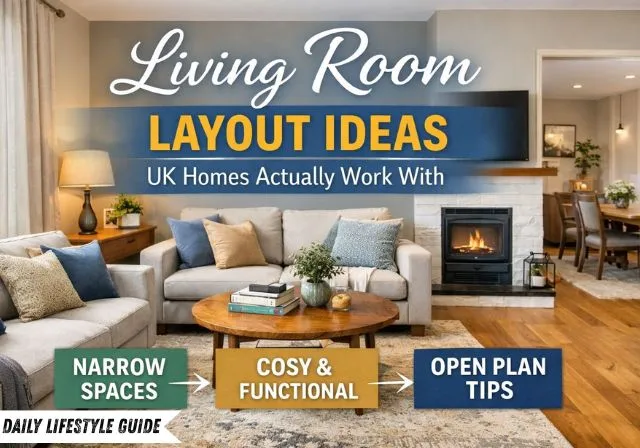

The best living room layout depends on the shape of your room, but a few rules work almost everywhere. Choose one focal point, pull the sofa off the wall if you can, keep main walkways about 80–90 cm (31–35 in) wide, and put at least the front legs of your seating on a rug. Below are 20 living room layout ideas UK homeowners and renters can copy, grouped by room shape, size, feature, use and furniture, with the measurements to check before you move anything.
Quick answer: which layout suits your room?
- Narrow room: split it into two zones, or use a corner sofa as a divider (Layouts 1 and 2).
- Rectangular room: face the sofa towards a focal point on the short wall and add a second zone at the far end (Layout 3).
- Square room: sofa plus two armchairs, or two sofas facing each other, around one rug (Layouts 4 and 5).
- Small room: one compact sofa, a multi-use footstool and a clear walkway (Layout 7).
- Open plan: sofa back to the dining area, with a rug under the seating (Layout 15).
Layout Rules and Measurements to Check First
Most layout problems come down to four things: no clear focal point, blocked walkways, furniture pushed to the walls, and a rug that is too small. Fix those and almost any room works better. Spacing advice varies between guides, so the table below gives a range and names who says what. Measurements are in centimetres, with inches in brackets.
| What to measure | Typical range | Notes |
|---|---|---|
| Main walkway between furniture | 80–90 cm (31–35 in) | Neptune says at least 80 cm. FCI London says 76–91 cm where possible. |
| Tight walkway (minimum) | 45–60 cm (18–24 in) | Fine for a rarely used route only. |
| Sofa to coffee table | 35–50 cm (14–20 in) | Guides range from 30 cm to 50 cm. Go closer in small rooms. |
| Seat to seat for chatting | No more than 2.4 m (8 ft) | Several design guides agree on this upper limit. |
| Rug beyond sofa edges | 15–30 cm (6–12 in) each side | FCI London says 15 cm minimum, 20 cm preferred. Others say 20–30 cm. |
| TV centre height | About 107 cm (42 in) | Roughly seated eye level. Measure your own. |
Chart: sofa-to-coffee-table gap by source (cm)
Sources: Neptune, Casa Padrino, A2Z Living Room Specialists and Mega Furniture retailer guides. Bars show each source’s range; Neptune gives a minimum.
Chart: recommended walkway width by source (cm)
Where a source gives only a minimum, the bar runs to the edge of the chart. No UK regulation sets a furniture spacing figure for ordinary living rooms.
The two spacing rules that matter most in a seating area
How the 20 Layouts Are Grouped

Every great layout starts with understanding your room shape
Image source: pixaby
Stand in the doorway and look at where the light comes in, where people walk, and where your eye lands first. Those three things decide your layout more than the furniture does. Neptune suggests using fireplaces, windows and chimney breasts as centre lines to arrange furniture around, and marking out where pieces will sit with masking tape before you move anything heavy. If you want a wider look at planning the whole room, our how to plan a living room UK guide covers the steps in order.
Find your room shape first, then check the layouts for any features it has, such as a bay window or fireplace. Most rooms suit two or three of the layouts below at once.
All 20 layouts at a glance
| # | Layout | Best for | Main watch-out |
|---|---|---|---|
| 1 | Long narrow: two zones | Terraces, long lounges | Needs a second rug |
| 2 | Long narrow: corner sofa divider | Narrow rooms with one wall free | Sofa can block the only route |
| 3 | Rectangular: main group plus second zone | Most UK lounges | Empty far end |
| 4 | Square: sofa and two armchairs | Balanced, tidy rooms | Few seats for guests |
| 5 | Square: two sofas facing | Entertaining | Two sofas need space |
| 6 | L-shaped: two rectangles | Knocked-through rooms | Seating spread too thin |
| 7 | Small: compact and clear | Flats, small lounges | Too many focal points |
| 8 | Large: two floating groups | Big rooms | Furniture lost on the walls |
| 9 | Fireplace focal point | Period homes | Heat and safety |
| 10 | Bay window, shallow sofa | Shallow bays | Blocking handles |
| 11 | Bay window, deep sofa | Deep sofas, sectionals | Bay left unused |
| 12 | TV wall | TV-first families | Sofa-to-TV distance |
| 13 | Alcoves and chimney breast | Period and 1930s homes | Blocked sockets |
| 14 | Patio or garden doors | Rooms opening to a garden | Blocked door route |
| 15 | Open-plan living and dining | Kitchen-diners | Furniture clashing at zone edges |
| 16 | Family room with play space | Families with children | Seating area lost to toys |
| 17 | Living room with a home office | Home workers | Cables and clutter |
| 18 | Reading-led, TV-free | Quiet, conversation-led rooms | Weak lighting |
| 19 | Corner sofa | Small to medium rooms | Wrong-handed model |
| 20 | Floating sofa with console | Large and open rooms | No room to pass behind |
The 20 layouts in this guide, grouped
- By room shape: 6 (30%)
- By room size: 2 (10%)
- By room feature: 6 (30%)
- By use: 4 (20%)
- By furniture: 2 (10%)
Layouts by Room Shape
Room shape sets the basic plan, so start here.
Layout 1: Long Narrow Room, Two Zones

Smart furniture placement can open up narrow UK living rooms
Image source: pixaby
A narrow room feels like a corridor when every piece sits on the long walls. The fix is to think in zones. Plan two seating areas across the room instead of one long row, put a rug under each, and angle the sofa slightly off the wall so the walking path bends. The Brain & The Brawn also shows long rooms split into separate zones, one around a fireplace and one with two facing chairs.
Two zones and one open route stop a narrow room feeling like a corridor (illustrative plan)
Best for: terraced houses and long lounges | Watch out: you need two rugs, so size the first one before buying the second
Layout 2: Long Narrow Room, Corner Sofa Divider
Neptune suggests anchoring a TV cabinet or dresser on one wall, letting a corner sofa extend into the room, and putting a console table behind it. Use a square coffee table rather than a long one, and turn the far end into a reading corner or small desk. For more ways to make tight UK homes work, see our narrow house interior ideas.
Best for: narrow rooms where one long wall is free | Watch out: in a very narrow room an L-shaped sofa can block the only walking route, so check the gap beside it first
Layout 3: Rectangular Room, Main Group Plus Second Zone

Zoning helps balance rectangular living rooms
Image source: pixaby
A rectangular room gives you options but can end up crowded at one end and empty at the other. Put the sofa opposite the TV unit or fireplace, add two armchairs angled slightly towards the focal point, and set a coffee table between them. Then give the other end a job, such as a reading chair, a desk or a dining table. Barker & Stonehouse notes that a rug creates a border that defines a space, and that sofas and freestanding shelving can divide a lounge. Pulling the sofa a few centimetres off the wall also adds depth. If your room opens into the kitchen, see our open plan living room ideas UK for more zoning options.
Best for: most UK living rooms | Watch out: the far end stays empty unless you give it a purpose
Layout 4: Square Room, Sofa and Two Armchairs
Square rooms suit balanced layouts. The classic is a sofa facing the focal point with an armchair either side and a coffee table on a rug in the middle. It looks tidy and works well when you rarely host more than four.
Sofa and two armchairs around one rug (illustrative plan)
Best for: tidy, balanced rooms and smaller households | Watch out: it leaves you short of seats when guests come
Layout 5: Square Room, Two Sofas Facing
If you need more seating, face two similar sofas across a coffee table and add an armchair at each end. Keep seats within about 2.4 m (8 ft) of each other so people can talk without raising their voices. If the room has an open doorway, do not block it with a second sofa.
Best for: entertaining and larger households | Watch out: two sofas leave less floor, so keep to the walkway ranges in the table above
Layout 6: L-Shaped Room, Two Rectangles
Treat an L-shaped room as two smaller rectangles instead of one awkward space. Put the main seating group in the larger leg, with a rug under it, and give the second leg a clear job, such as dining, a desk or a reading chair. Angle the sofa so its back faces the corner where the two legs meet, and the sofa itself marks the edge of the living zone. Keep a straight, open route between the two zones so nobody has to walk through the seating.
Each leg of the L gets one job (illustrative plan)
Best for: knocked-through rooms and extensions | Watch out: seating spread across both legs makes the room feel disconnected
Layouts by Room Size
Layout 7: Small Room, Compact and Clear
In a small room, flow matters more than symmetry. Choose a slim-framed sofa, use a footstool with trays as both table and spare seat, and add shelves and a mirror on a wall to save floor space. Keep about 50 cm (20 in) between sofa and coffee table, or a little less if the room is very tight. Stick to one statement piece, such as an armchair or a piece of art, so the eye has somewhere to land. Armless sofas and chairs also keep sightlines open. For more ideas, see our small living room layout ideas UK guide, or choose a small living room coffee table that does not block the route.
Best for: flats and small lounges | Watch out: more than one statement piece makes the room feel busy
Layout 8: Large Room, Two Floating Groups
A big room is easy to get wrong because furniture pushed to the walls leaves a hole in the middle. Pull seating into one or two groups instead, each with its own rug and its own focal point. Keep seats within each group about 2.4 m (8 ft) apart at most, so people can still talk. Use a console, bookcase or the back of a sofa to separate the groups, and keep a clear route between them.
Best for: large lounges and through-rooms | Watch out: groups placed too far apart feel like separate rooms
Layouts by Room Feature
Layout 9: Fireplace as the Focal Point
Let the fireplace lead. Face the sofa towards it with a coffee table on a rug between them. Instead of squeezing every seat up to the hearth, add a neat pair of cocktail-style chairs either side, or a club fender for a discreet perch. Neptune advises keeping the fireplace or a large piece of art as the focal point, rather than the television, and using a media cabinet to keep screens discreet. If the TV has to share the wall, our classic British living room ideas show how to balance the two. For a warmer look around the hearth, try our cosy living room ideas for winter UK. Safety matters here, so read the Accessibility and Safety section below.
Best for: period homes and rooms with a working fire or stove | Watch out: heat and clearances, so follow the manufacturer’s instructions
Layout 10: Bay Window With a Shallow Sofa
If your sofa is shallow, push it back into the bay, add an armchair each side, and angle one chair towards the window. Do not block the glass or the window handles. Blinds can also cut light from the top of the window, so curtains or shutters are often the better choice for letting in light.
Best for: shallow sofas and rooms that need the bay as a seating spot | Watch out: a sofa that is too deep will not fit the angled walls
Layout 11: Bay Window With a Deep Sofa
A deep sofa or sectional is better kept out of the bay. Use the bay for a reading chair or window seat, and place the sofa on the opposite wall so the window becomes your view. A round or oval rug softens the angled walls.
Best for: deep sofas and sectionals | Watch out: an unused bay can feel wasted unless it gets a chair or a seat
Layout 12: TV Wall Layout

Position your seating for comfortable TV viewing
Image source: pixaby
For a TV-first room, centre the sofa opposite the screen, keep the path between them clear, and flank the sofa with armchairs angled towards the TV. In a tight room, swivel chairs let people face the screen or each other without moving the furniture. Place the middle of the screen at roughly seated eye level, about 107 cm (42 in) from the floor for most people.
How far the sofa should be from the TV is where sources disagree most. Which? gives larger distances than some retailers, so use the table as a guide and test with your own sofa. A bigger set or lower resolution means sitting further back.
| TV size | Which? | Vebos (retailer) |
|---|---|---|
| 55 inch | 3.4–3.7 m (11–12 ft) | 2.1–2.5 m (7–8 ft) |
| 65 inch | 4 m (13 ft) | 2.5–3 m (8–10 ft) |
| 75 inch | 4.6 m (15 ft) | 2.9–3.4 m (9.5–11 ft) |
Chart: sofa-to-TV distance, 55 inch set (metres)
The gap between the two sources is wide. Treat the answer as a range and test with tape on the floor.
If you are short of floor space, a small living room TV unit can help keep the screen slim and the walkway clear. Choosing seating? Our corner sofa vs standard sofa UK guide can help you find the right fit.
Best for: TV-first families | Watch out: sources disagree on the sofa-to-TV distance, so test with tape
Layout 13: Alcoves and Chimney Breast
Alcoves either side of a chimney breast give you a ready-made centre line. Put the sofa or the TV on that line and use the alcoves for shelves, a cabinet or a built-in desk, so the storage stays off the floor. Check where the sockets are before you place anything in front of them. If you like open shelving, our living room open shelving ideas UK has styling ideas.
Best for: period and 1930s homes | Watch out: furniture that blocks sockets or radiators
Layout 14: Patio or Garden Doors
Keep the route to patio or garden doors open and keep the door swing clear. The walkway range in the table above applies here too. A sofa with its back towards the doors can work if people can still pass. Avoid putting the TV directly opposite bright glass, as the screen can be hard to see in daylight. A rug and a pair of armchairs near the doors can turn the spot into a sitting area.
Best for: rooms that open onto a garden | Watch out: a blocked door route, especially in summer
Layouts by Use
Layout 15: Open-Plan Living and Dining
Without walls, the furniture does the dividing. Put the back of the sofa towards the dining area, lay a generous rug under the seating, and add a console behind the sofa if you want storage or lamps. For a firmer split, a short stud wall or tall bookcase works, though a stud wall is not a renter option. Pulling the sofa off the wall also lets its back form a walkway, so people pass behind the seating rather than through it. Check that any recliner or sofa bed can open without hitting a dining chair. For colour and finish ideas that tie the zones together, see our open plan living room decor UK guide.
A sofa back and a rug mark the living zone without a wall (illustrative plan)
Best for: kitchen-diners and open-plan homes | Watch out: recliners and chairs clashing where the zones meet
Layout 16: Family Room With Play Space
Give toys and activities their own section of the room so the seating area stays usable. A coffee table with storage helps, and leaving open floor in the middle gives children space to play. Keep storage within easy reach and choose softer furniture edges where you can. Our family living room ideas UK guide has more practical options.
Best for: families with young children | Watch out: toys can take over the seating area without dedicated storage
Layout 17: Living Room With a Home Office
Put the desk at the far end of the room or behind the sofa, so work stays out of the main seating view. A narrow console can double as a desk. Angle the chair so the screen faces away from the TV zone, and keep cables tidy to avoid trip hazards. Choose pieces that fold away or do two jobs, as in our multifunctional living room furniture UK guide, and see our smart home office setup ideas for the desk itself.
Best for: home workers and small flats | Watch out: cables and paperwork spreading into the seating zone
Layout 18: Reading-Led, TV-Free Layout
Without a TV, the room can be arranged for conversation and reading. Face two armchairs or a sofa and chair towards each other, with a side table between them, ideally by a window or fireplace. As Neptune suggests, keep the main lighting at seated eye level, so table lamps work better than a single ceiling light. For nook ideas, see our living room reading corner ideas.
Best for: quiet, conversation-led rooms | Watch out: weak lighting makes the reading spot hard to use
Layouts by Furniture
Layout 19: Corner Sofa Layout
A corner sofa groups your seating into one zone and leaves more open floor. It works tucked into a corner, floating as a divider, facing the TV, or with the chaise end under a window to keep light and sightlines open. Check whether you need a left-hand or right-hand model: one directs traffic into the room, while the other can block it. Keep the rest of the room light on heavy furniture, and remember that a showroom sofa can look smaller than it will in your lounge. Before you buy, read our corner sofa buying guide UK.
Best for: small to medium rooms that need lots of seats | Watch out: ordering the wrong-handed model
Layout 20: Floating Sofa With a Console Behind
In a large or open room, pull the sofa away from the wall and put a console table behind it. The console gives you somewhere for lamps, books and baskets, and the sofa back becomes a clear edge. If people will walk behind the sofa, keep that gap within the 80–90 cm (31–35 in) walkway range. Run lamp cables along the wall or the back of the console so they do not trail across the floor.
Best for: large and open rooms | Watch out: not leaving enough room to pass behind the sofa
Rug Size and Placement
A rug that is too small makes a layout feel disconnected. The common minimum is to get at least the front legs of every seat on the rug. Rug retailers suggest the sizes below, and they do differ, so treat them as a starting point.
| Seating group | Suggested rug size | Source |
|---|---|---|
| Two-seater in a small room | 160 × 230 cm (5 ft 3 in × 7 ft 7 in) | Casa Padrino, Nain Trading (minimum) |
| Sofa plus armchairs, front legs on | 200 × 300 cm (6 ft 7 in × 9 ft 10 in) | Rugtales, Nain Trading |
| Three-seater plus two armchairs | 250 × 350 cm (8 ft 2 in × 11 ft 6 in) | Casa Padrino |
| Large corner group, all legs on | 300 × 400 cm (9 ft 10 in × 13 ft 1 in) | Casa Padrino |
FCI London lists 240 × 300 cm and 270 × 360 cm as common living room sizes, and says the rug should extend at least 15 cm (6 in) beyond each side of the sofa, with 20 cm (8 in) preferred. If you plan to put all furniture legs on the rug, leave about 20 cm of rug showing around the group. For small-room options, see our small living room rug ideas UK.
Lighting Placement Within Layout
Plan light as part of the layout. Neptune advises that core lighting should sit at eye level when you are seated, which means table lamps. Layer dimmable overhead light with table lamps for mood and task lights for reading. A pair of lamps on side tables either side of the sofa spreads light evenly, and a taller floor lamp behind an armchair adds depth. Place lights beside seating, reading spots and along walkways. Our guide to living room lighting ideas around your sofa shows where each light works best.
Symmetry vs Asymmetry: What Works Best?
Symmetry, with matching sofas or a chair either side of a fireplace, gives a formal, orderly feel. An uneven arrangement feels more relaxed. Neither is right for every home. Pick symmetry if you like order and the room has a strong centre line, and asymmetry if the room is small or you want a casual look. A good compromise is a symmetrical seating group with a few mismatched side tables and lamps. If you prefer a calmer, simpler look, try our minimalist living room ideas UK.
Layout Mistakes That Shrink UK Living Rooms
| Mistake | Easy fix |
|---|---|
| Pushing all furniture against the walls | Pull seating inward and group it around a focal point. |
| Rug too small | Get at least the front legs of every seat on the rug. |
| Sofa too big for the room | Choose seating in proportion to the room. Oversized pieces make it feel narrow. |
| Blocking a doorway or main route | Keep open doorways clear and keep the garden route out of the TV area. |
| Coffee table too far from the seats | Put an occasional table beside every seat. |
| Seats set too far apart | Bring the group together, within about 2.4 m (8 ft). |
| Too many focal points | In a small room, pick one statement piece. |
Sometimes the best fix is to remove one piece. If you are unsure what to change, our list of living room decor mistakes covers the finishing touches too.
Layout Tips for Renters
Rearranging costs nothing and leaves no marks, so it is the best renter fix. Use these changes:
- Use a rug to define the living zone, and the sofa’s position to mark a second zone (see Layout 15).
- Add table lamps instead of rewiring.
- Use adhesive hooks or picture strips only on suitable, fully cured surfaces, follow the instructions, and check your tenancy agreement.
- Avoid tall unanchored shelves as dividers, as tall units may need anti-tip fixing.
Our living room ideas for rental property UK guide has more no-drill ideas.
Accessibility and Safety
Accessibility. Where the room allows, keep a clear turning circle of 1,500 mm (59 in). The Centre for Accessible Environments says living rooms in Lifetime Homes should allow this, or an ellipse of 1,700 × 1,400 mm, and that coffee and side tables may overlap that space. These are standards for new and adaptable homes, so use them as a guide in an existing room.
Fires and stoves. Upholstered furniture burns easily, and electric fires give off heat too. Distances vary by appliance, so follow the manufacturer’s manual and use a HETAS-registered installer for stoves. Do not rely on a single distance from an article.
TV above a fireplace. Heat and viewing height both matter, so check the TV maker’s guidance. The wall mount must carry the TV’s weight, and cables above a fireplace are hard to hide neatly. Never run cables through a flue.
Budget-Friendly Layout Improvements
| Budget | What to do |
|---|---|
| Free | Pull furniture off the walls, tape out the plan, turn the sofa to a new focal point, zone with a rug you already own. |
| Low cost | Buy a rug sized to the seating group, table lamps, and occasional tables beside each seat. |
| New furniture | Corner sofa, console behind a sofa, storage coffee table, media cabinet. |
Start free and only buy once you know what the room is missing. If you do buy a sofa, our sofa buying guide UK explains how to check size and comfort. For colour choices that suit your new layout, see our living room colour scheme guide UK.
Free Room Planners and the Tape Method
The cheapest planner is masking tape. Measure your furniture, mark each piece’s footprint on the floor, then walk around it. If it feels tight, move the tape, not the sofa. For a screen version, online tools such as Arcadium 3D, Coohom and Homestyler describe themselves as free to start, though paid options and limits are not clear, so check before relying on one. Always measure doorways and hallways before ordering large furniture.
Final Thoughts
The 20 layouts above all follow the same logic, and a good layout is not about strict rules. Pick a focal point, keep walkways clear, pull furniture into a group, and anchor it with a rug that is big enough. Designers are also pushing conversation-first seating at the moment, which suits most UK rooms. Start by taping out one change today and see how it feels.
Sources
- Neptune: living room layout ideas
- Which?: what size TV should I buy
- FCI London: living room rug sizes
- Vebos: ideal TV viewing distance
- Casa Padrino: rug size guide
- Centre for Accessible Environments: circulation space
Author Bio
Editorial Team
The Editorial Team at Daily Lifestyle Guide shares practical advice tailored for UK homeowners, helping create living spaces that are functional, stylish, and suited to everyday life.
Disclaimer
This article is for general home inspiration only. Layout suitability may vary depending on your property. Spacing figures differ between sources and are given as ranges. For fires, stoves, TV mounts and wall fixings, always follow the manufacturer’s instructions and use a qualified installer. The Daily Lifestyle Guide editorial team may update this content as trends and best practices evolve.
FAQs
What is the best living room layout for UK homes?
It depends on room shape. Narrow rooms suit two zones, rectangular rooms suit a main seating group plus a second zone, and square rooms suit a balanced group around a rug. In every case, keep walkways clear and choose one focal point.
How much space should be between furniture?
Aim for 80–90 cm (31–35 in) on main routes. A tight minimum is 45–60 cm (18–24 in) on rarely used routes. Between sofa and coffee table, most guides suggest about 35–50 cm (14–20 in).
Is it better to place a sofa against the wall?
Not always. Pulling it slightly away adds depth and can let you use the back as a walkway or divider. In some long, narrow rooms, a sofa along the wall is the better choice, so test both with tape.
How far should the sofa be from the TV?
Sources disagree. For a 55 inch TV, Which? gives 3.4–3.7 m, while one retailer gives 2.1–2.5 m. Use the Which? calculator, allow for your TV’s resolution, and test the position before fixing anything to the wall.
What size rug do I need for a living room?
Get a rug large enough for at least the front legs of every seat. For a sofa and armchairs, 200 × 300 cm is a common choice, and larger groups may need 250 × 350 cm or more.
Why does my living room feel smaller than it is?
It is usually layout, not size. Oversized furniture, blocked walkways, furniture pushed to the walls and a rug that is too small are the common causes.
How do I zone an open plan living room?
Use a rug under the seating, turn the sofa’s back to the dining area, and add a console behind it if you want a clearer edge. Keep a walkway behind the sofa.
Can I change my layout in a rented home?
Yes. Rearranging furniture, using rugs to zone and adding lamps need no drilling. Check your tenancy agreement before using adhesive hooks on walls.
Which layout is best for an L-shaped or large living room?
Treat an L-shaped room as two rectangles, with seating in the larger leg and a second job in the other. In a large room, pull furniture off the walls into one or two rug-defined groups. See Layouts 6 and 8.